

A practical procurement guide for importers, distributors, confectioners and private-label brands in the EU and UK
By Mr. Ravanshad — Export Manager, Qomes Tejarat Asia (PistaLuxe)
WhatsApp: 00989214773705 · Email: info@pistaluxe.com
Introduction: The Paradox Every European Buyer Is Living Through
If you have tried to buy pistachios in bulk in Europe at any point in the last two years, you already know the paradox. Demand has never been stronger. Retail shelves are emptying faster than they can be refilled. Pistachio-flavoured products — from the viral Dubai chocolate bar to pistachio cream, gelato, protein bars and plant-based spreads — have moved from novelty to permanent category. And yet, sourcing has never felt more fragile.
Prices spiked dramatically in early 2025. Availability of shelled kernels tightened because a large share of the global crop was sold in-shell. Some manufacturers reformulated recipes. Others simply could not secure enough raw material at a workable margin. Meanwhile, European border controls on aflatoxin have grown stricter, and a single rejected container can wipe out an entire season’s profit for a mid-sized importer.
This article is written for the people on the buying side of that equation. It is not a sales brochure. It is a working guide to the real problems in the pistachio supply chain — and to the practical, verifiable solutions that professional buyers use to protect their margins, their brands and their delivery schedules.
At Qomes Tejarat Asia, we have spent years on the exporting side of Iranian pistachios, and we have seen both the failures and the fixes. What follows is what we would want to know if we were sitting on your side of the table.
## Chapter 1: The Global Pistachio Market in Plain Numbers
Understanding the market structure is the first step to negotiating well. Pistachios are not a commodity like wheat or sugar. They are a specialty tree nut with a long production cycle, a highly concentrated growing geography, and a demand curve that has recently broken away from its historical pattern.
**Production concentration.** Three countries dominate global supply: the United States, Iran and Turkey. In a normal year, these three account for the overwhelming majority of world output. This concentration means that a single bad harvest, a frost event, a water shortage or a trade restriction in one country can move global prices within weeks.
**The 2024–2025 shock.** The 2024 California crop came in as an “off year,” with output reported well below the previous season. Because California is the largest single supplier to Europe, the shortfall was felt immediately. International prices that had been trading in the mid-teens per kilogram moved into the low twenties, and European wholesale prices rose by roughly a third. Retail prices followed, climbing 20–30% in many markets.
**The demand side surprise.** Just as supply tightened, demand accelerated. The “Dubai chocolate” phenomenon — a chocolate bar filled with pistachio cream and crisp kataifi pastry — went viral across social media and triggered a global run on pistachio kernels and pistachio paste. Iran’s exports to the UAE reportedly rose by around 40% in the six months to March 2025. Confectionery manufacturers across Europe scrambled to launch pistachio lines, and industrial buyers who had never purchased pistachios before suddenly needed tonnage.
**The result.** A market that was already tight became a seller’s market. Buyers who had relied on spot purchases at the last minute found themselves paying premiums, accepting lower grades, or going without.
**The lesson.** In a concentrated, volatile market, the buyers who win are the ones with relationships, specifications and contracts in place before the shortage hits — not the ones who start searching when their stock is already at zero.
—
## Chapter 2: Problem One — Aflatoxin and the European Border
This is the single most consequential technical issue in the entire trade, and it deserves more attention than it usually receives in supplier marketing.
### What aflatoxin actually is
Aflatoxins are toxic compounds produced by moulds of the *Aspergillus* family, principally *Aspergillus flavus* and *Aspergillus parasiticus*. They are not a surface contaminant that can be washed off. They are metabolic by-products that form inside the nut when conditions favour fungal growth. Aflatoxin B1 is classified as a Group 1 human carcinogen, and European regulators treat it accordingly.
### The legal limits you must know
Under EU Regulation 2023/915, pistachios intended for direct human consumption must not exceed:
– **8 μg/kg** for aflatoxin B1
– **10 μg/kg** for total aflatoxins (B1 + B2 + G1 + G2)
For nuts intended for further processing or sorting before consumption, the limits are higher:
– **12 μg/kg** for aflatoxin B1
– **15 μg/kg** for total aflatoxins
These are not targets to aim for. They are ceilings. A responsible supplier works to a fraction of the legal limit so that sampling variance does not push a compliant lot over the line.
### Why this is harder than it sounds
Aflatoxin contamination is not evenly distributed. It is highly localised — a handful of nuts in a tonne can carry almost all the toxin. This creates a statistical problem: a sample that tests clean does not guarantee that the lot is clean. EU sampling rules (Regulation (EC) 401/2006 and its successors) are designed around this reality, requiring incremental sampling and laboratory analysis by a defined method.
### What actually causes contamination
The conditions that drive aflatoxin risk are well understood:
– Warm, humid weather during the final stages of maturation
– Rain or irrigation close to harvest
– Delayed hulling after picking
– Slow or uneven drying
– Storage above roughly 25°C or at elevated humidity
– Long transit times with temperature fluctuation
– Condensation inside containers during sea freight
In other words, most aflatoxin failures are process failures, not bad luck. They happen when a supplier rushes harvest, dries poorly, stores carelessly, or ships without controlling container conditions.
### The solution: defence in depth
Professional exporters do not rely on a single laboratory test at the end. They build layers:
1. **Orchard-level management** — irrigation scheduling, pest control, and harvest timing that avoids late-season moisture.
2. **Rapid hulling** — removing the hull within hours of harvest, not days.
3. **Controlled drying** — reducing moisture to a safe target quickly and evenly.
4. **Optical and manual sorting** — removing discoloured, damaged and suspect nuts with colour sorters and trained sorters, often in multiple passes.
5. **Acreage-level traceability** — knowing which orchard, which lot, which drying batch.
6. **Accredited laboratory testing** — HPLC-based analysis at an ISO/IEC 17025 laboratory, with certificates issued per lot.
7. **Container and transit control** — desiccant, ventilation, and route planning to avoid heat exposure.
When a supplier can show you all seven layers, the aflatoxin conversation changes from a risk to a routine.
### What to ask your supplier
– Which laboratory issues your certificates, and is it ISO/IEC 17025 accredited?
– Do you test per lot or per shipment?
– What is your internal action limit, and how far below the EU ceiling is it?
– Can you provide historical test results across multiple shipments, not just the current one?
– What is your documented procedure if a lot fails?
A supplier who cannot answer these questions clearly is a supplier who has not yet had a problem. That is not the same as a supplier who will not have one.
—
## Chapter 3: Problem Two — Price Volatility and the “Cheap Pistachio” Trap
When prices rise sharply, the market fills with offers that look too good. Some are legitimate — a seller liquidating old crop, a trader with a genuine surplus. Most are not.
### Where suspiciously cheap pistachios come from
– **Old crop sold as new.** Pistachios from a previous season, stored poorly, with degraded colour, rancid oils and higher aflatoxin risk.
– **Mixed varieties.** Fandoghi sold as Akbari. Lower-grade lots blended into higher-grade consignments.
– **Inflated open-shell percentages.** A “95% open shell” claim that is actually 80% once the container is opened.
– **Undisclosed defects.** Hidden staining, insect damage, or excessive closed and blank nuts.
– **Weight tricks.** Moisture content above the agreed specification, which means you are paying for water.
– **Missing documentation.** No phytosanitary certificate, no certificate of origin, no lab report — until after you have paid.
### The real cost of a cheap container
Suppose you save 8% on the purchase price. Then the container arrives with 12% more closed shells than specified, moisture at 7% instead of 5%, and a lab result that forces re-sorting. Your re-sorting cost, your yield loss and your delivery delay will almost certainly exceed the 8% you saved. And if the lot is rejected at the border, the loss is not 8% — it is the full value of the goods plus freight, plus demurrage, plus the cost of the customer you could not supply.
Cheap pistachios are rarely cheap. They are simply expensive in a different currency.
### How to price properly
Professional buyers evaluate offers on a **cost-per-kilogram-of-usable-kernel** basis, not on invoice price. That means adjusting for:
– Open-shell percentage
– Moisture content
– Defect and foreign-matter allowance
– Kernel yield per kilogram of in-shell product
– Freight, insurance and duty
– Rejection and re-sorting risk
Two offers that differ by 10% on paper can be functionally identical once these factors are applied — or one can be far worse than it looks.
—
## Chapter 4: Problem Three — Variety Confusion and Misrepresentation
Iranian pistachios are not one product. They are a family of distinct cultivars with different size, shape, colour, flavour, yield and price. Confusion between them is one of the most common sources of dispute in the trade.
### The four commercial varieties
**Akbari.** The largest and most elongated of the Iranian varieties, with a distinctive almond-like shape. Akbari commands the highest price and is prized for premium retail packs, gift packaging and markets where visual size is the selling point. It has excellent flavour and a high kernel-to-shell ratio, but lower yields per hectare, which is part of why it is expensive.
**Ahmad Aghaei.** Long, slender and elegant, with a pointed tip. Ahmad Aghaei is the variety most associated with premium export presentation and is highly regarded in Gulf and European premium markets. It offers strong visual appeal and good flavour, and is often the choice for branded retail where appearance drives purchase.
**Fandoghi (Round).** The workhorse of Iranian pistachios. Round, compact and consistent, Fandoghi is the most widely planted variety and the most price-competitive. It is the natural choice for industrial use, bulk retail, roasting operations and private label where cost efficiency matters more than elongation. Its round shape also makes it well suited to automated sorting and packaging lines.
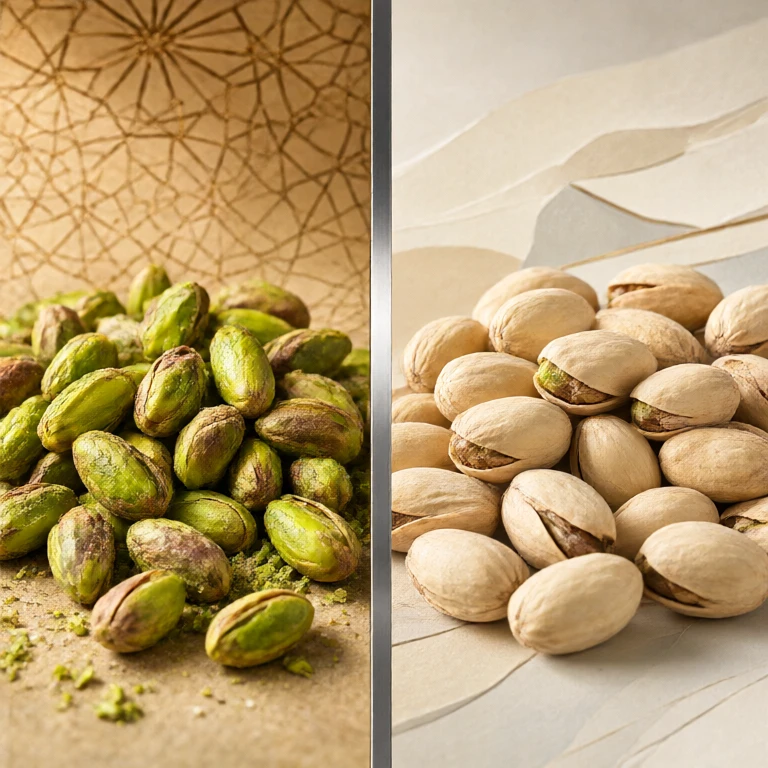
**Kalleh Ghoochi.** A larger, broader nut with a naturally open shell and a distinctive appearance. Kalleh Ghoochi is popular in markets that favour big, well-opened nuts and is often used in mixed premium assortments. Its shell opening is generally generous, which supports high open-shell percentages.
### Why the distinction matters commercially
If you are a confectionery manufacturer producing pistachio paste, the visual shape of the nut is irrelevant — what matters is kernel yield, colour, flavour intensity and cost per kilogram of kernel. Fandoghi or a kernel-grade lot may serve you better than Akbari at a lower price.
If you are a retailer selling 500g packs on a premium shelf, shape and size are the product. Akbari or Ahmad Aghaei may justify a higher price point.
If you are supplying the food service sector for roasting and salting, consistency of size and open-shell percentage matter more than cultivar prestige.
### The solution: specify, sample, verify
– **Specify the cultivar by name** in the contract, not just “Iranian pistachio.”
– **Specify the grade** — size count per ounce, open-shell percentage, closed-shell allowance, blank allowance, moisture, defect tolerance.
– **Request a pre-shipment sample** from the actual lot, not from a generic reference batch.
– **Ask for photographs and video** of the lot before shipment.
– **Verify with an independent inspection** for larger orders.
A supplier who resists naming the cultivar and grade in writing is telling you something important.
—
## Chapter 5: Problem Four — Grades, Specifications and the Language of the Trade
Much of the friction in pistachio buying comes from vague specifications. “Good quality” is not a specification. “Export grade” is not a specification either — it means different things to different sellers.
### The metrics that actually define a lot
**Size count.** Expressed as the number of nuts per ounce (28.35 g). Lower numbers mean larger nuts. Common ranges run from around 18/20 for very large Akbari down to 30/34 for smaller Fandoghi. Always confirm whether the count is measured on in-shell or kernel product.
**Open-shell percentage.** The share of nuts with a visibly open shell. Premium retail lots typically target 95% or higher; industrial lots may accept lower.
**Closed-shell and blank allowance.** Closed shells and empty (blank) nuts reduce usable yield and should be capped explicitly.
**Moisture content.** Typically specified in the 4–6% range for export. Higher moisture means higher weight, higher mould risk and shorter shelf life.
**Defect tolerance.** Stained, shrivelled, insect-damaged and broken nuts should each have an agreed maximum.
**Colour.** Kernel colour ranges from green to yellow. Green kernels command a premium in confectionery and ice cream applications.
**Crop year.** Always stated. Old crop is not inherently bad, but it must be disclosed and priced accordingly.
**Packaging.** Bulk (typically 10 kg, 20 kg or 25 kg bags), vacuum packs, or retail-ready formats.
### A specification table you can adapt
| Parameter | Typical premium retail | Typical industrial / processing |
|—|—|—|
| Cultivar | Akbari / Ahmad Aghaei / Kalleh Ghoochi | Fandoghi or kernel grade |
| Size count (nuts/oz) | 20/22 to 26/28 | 28/30 to 32/34 |
| Open shell | ≥ 95% | ≥ 80–90% |
| Closed shell | ≤ 3% | ≤ 8% |
| Blank / empty | ≤ 1% | ≤ 2% |
| Moisture | ≤ 5% | ≤ 6% |
| Defects | ≤ 1–2% | ≤ 3–5% |
| Crop year | Current | Current or disclosed prior |
| Packaging | 10–25 kg bulk or retail-ready | 20–25 kg bulk |
Adapt these numbers to your own product and market, then put them in the contract. The table is not the point — the discipline of writing it down is.
—
## Chapter 6: Problem Five — Logistics, Transit and the Hidden Damage of Sea Freight
Pistachios are a living product. They continue to respire, they absorb moisture, and they are sensitive to heat. A container that is perfectly fine at loading can be compromised by the time it reaches Rotterdam, Hamburg, Genoa or Valencia.
### The specific risks
**Heat exposure.** Temperatures above roughly 25°C accelerate oxidation and create conditions for mould growth. Containers sitting on a quay in summer, or routed through hot climates, can reach far higher internal temperatures.
**Condensation.** Temperature swings between day and night, or between climates, cause moisture migration inside the container. Condensation on the container ceiling can drip onto bags.
**Poor ventilation.** Inadequate air circulation concentrates humidity in pockets.
**Handling damage.** Rough handling breaks shells and creates fines, which reduce visual grade and increase the risk of mould at broken surfaces.
**Documentation delays.** A container held at the port because a certificate is missing can sit in uncontrolled conditions for weeks.
### The solution
– **Use desiccant and moisture barriers** inside the container.
– **Choose routes and seasons** with temperature in mind, and consider reefer or ventilated options for high-value or long-transit shipments.
– **Load palletised and shrink-wrapped** where the buyer’s facility requires it.
– **Confirm Incoterms clearly.** FOB, CFR, CIF and DAP place very different responsibilities on buyer and seller. Know exactly where your risk transfers.
– **Build documentation checklists** and verify every certificate before the container leaves.
– **Track the shipment** and record temperature where possible.
A supplier who treats logistics as an afterthought is a supplier who has not yet paid for a spoiled container.
—
## Chapter 7: Problem Six — Documentation, Compliance and the Paperwork That Stops Containers
European importers face a documentation burden that is easy to underestimate. Missing or mismatched paperwork is one of the most common causes of border delays — and it is entirely preventable.
### The core documents
– **Commercial invoice** — with correct description, cultivar, grade, quantity and value
– **Packing list** — matching the invoice exactly
– **Bill of lading** or airway bill
– **Certificate of origin** — often required for preferential tariff treatment
– **Phytosanitary certificate** — issued by the exporting country’s plant protection authority
– **Laboratory analysis certificate** — aflatoxin, and where required, pesticide residues
– **Health certificate** — where the destination requires it
– **Food safety and traceability documentation** — supplier declarations, HACCP references, lot traceability
### The compliance framework to understand
– **Regulation (EU) 2023/915** — contaminant limits, including aflatoxins
– **Regulation (EC) 401/2006** — sampling and analysis methods for mycotoxins
– **Regulation (EU) 2019/1793** — the framework for increased official controls and emergency measures on certain food imports, which has historically affected pistachios from certain origins
– **Regulation (EC) 852/2004** — general food hygiene requirements
– **Regulation (EU) 2017/625** — official controls on food and feed
– **Maximum residue levels** under Regulation (EC) 396/2005 for pesticides
### The practical checklist
1. Confirm the exact document set required for your destination and product use.
2. Verify that names, weights and descriptions match across all documents.
3. Confirm the designated point of entry and any required pre-notification.
4. Check that laboratory certificates are issued for the actual lot being shipped.
5. Keep digital copies of everything, organised by lot number.
A small administrative error can cost weeks. A disciplined supplier treats documentation as part of the product.
—
## Chapter 8: Problem Seven — Traceability and the Brand Risk You Cannot See
For a European importer, a pistachio is not just a pistachio. It is a liability chain. If a retailer’s customer finds a foreign object, or a laboratory detects a contaminant, the question that follows is: where did this come from, and can you prove it?
Traceability is the answer, and it is increasingly a commercial requirement rather than a nice-to-have. Major retailers, private-label manufacturers and food service groups now expect suppliers to demonstrate:
– Which farm or region the lot came from
– When it was harvested and dried
– Which processing batch it passed through
– Which laboratory tested it and when
– Which container it shipped in
Without this, a recall becomes a guessing game, and a guessing game becomes a brand crisis.
### What good traceability looks like
– Lot numbers assigned at intake and maintained through processing, packing and shipping
– Farm or cooperative-level records
– Drying and storage logs
– Sorting and grading records
– Laboratory certificates linked to lot numbers
– Shipping documents that reference the same lot numbers
### What to ask
– Can you trace a finished bag back to a harvest batch?
– How long do you retain records?
– What happens if a customer complaint is traced to your lot?
If the answer is vague, the risk is yours.
—
## Chapter 9: Why Iranian Pistachios Remain a Premium Choice
Despite the challenges, Iranian pistachios occupy a special place in the global market, and for good reason.
**Flavour.** Iranian pistachios, particularly from the Rafsanjan region and surrounding areas, are widely regarded for their rich, buttery flavour and aromatic profile. This is a function of cultivar, soil, climate and the long tradition of cultivation in the region.
**Kernel colour.** Iranian kernels often show a desirable green tone, which is highly valued in confectionery, ice cream and paste applications where visual appeal matters.
**Varietal diversity.** The availability of Akbari, Ahmad Aghaei, Fandoghi and Kalleh Ghoochi gives buyers genuine choice across price points and applications — something single-variety origins cannot offer.
**Heritage and expertise.** Iran has cultivated pistachios for centuries. The knowledge embedded in growing, harvesting, hulling and sorting is a real competitive advantage.
**Scale.** Iran remains one of the world’s two largest producers, with the capacity to supply significant volumes to European markets.
The challenge for buyers is not whether Iranian pistachios are good. It is whether a given supplier can deliver them consistently, compliantly and on time. That is a supplier-selection problem, not an origin problem.
—
## Chapter 10: The Health and Consumer Story That Drives Demand
Understanding why demand is rising helps you plan your own product strategy.
Pistachios are nutritionally dense. A 28-gram serving (about 49 kernels) provides roughly 159 calories, 6 grams of protein, 3 grams of fibre and 13 grams of fat, along with meaningful amounts of vitamin B6, copper, manganese, phosphorus and potassium. They are among the most vitamin B6-rich foods available and contain more potassium per ounce than half a large banana.
They are also a source of antioxidants, including lutein and zeaxanthin, and of polyphenols and tocopherols. Research has associated nut consumption, including pistachios, with favourable effects on cardiovascular risk factors and with improved satiety. Pistachios are among the lower-calorie nuts per ounce, which supports their positioning in health-conscious snacking.
For product developers, this translates into several strong consumer narratives:
– **Protein and fibre** for the sports nutrition and healthy snacking categories
– **Lower calorie density** for weight-management positioning
– **Natural colour and flavour** for clean-label confectionery and ice cream
– **Plant-based** for vegan and vegetarian ranges
– **Premium indulgence** for gifting and seasonal lines
The Dubai chocolate trend demonstrated how quickly a single product concept can move an entire ingredient market. Brands that have reliable kernel and paste supply are positioned to capture that demand; brands that do not are spectators.
—
## Chapter 11: How to Choose a Pistachio Supplier — A Due Diligence Framework
This is the section to bookmark. It is a practical checklist you can apply to any supplier, including us.
### Stage 1: Desk research
– Does the company have a real, verifiable presence — website, address, registration?
– Is the product range specific, or generic?
– Are specifications published, or only available “on request”?
– Is there evidence of export experience to your region?
### Stage 2: Technical qualification
– Can they name the cultivar and grade precisely?
– Do they provide a written specification sheet?
– Which laboratory do they use, and is it accredited?
– What are their internal action limits versus legal limits?
– What is their documented procedure for a failed lot?
### Stage 3: Commercial qualification
– Are prices transparent and structured, or vague?
– Are Incoterms and payment terms clear?
– What are the lead times, and are they realistic?
– What is the minimum order quantity?
– How do they handle quality claims?
### Stage 4: Sample and verification
– Request a sample from the actual production lot.
– Compare it against the written specification.
– Consider third-party inspection for large orders.
– Ask for references from existing customers in your region.
### Stage 5: Trial shipment
– Start with a smaller order to test the full chain: documentation, logistics, communication, quality.
– Evaluate not just the product but the process.
– Scale up only after the trial proves reliable.
### Red flags
– Pressure to pay in full upfront with no inspection
– Refusal to name the cultivar or grade in writing
– No laboratory certificates, or certificates that cannot be verified
– Prices far below market with no explanation
– Vague or evasive answers about traceability
– No references and no verifiable export history
—
## Chapter 12: Packaging, Private Label and Value-Added Options
For many European buyers, the pistachio itself is only half the product. Packaging and presentation determine shelf appeal, logistics efficiency and brand positioning.
### Bulk formats
– **10 kg, 20 kg and 25 kg bags** — the standard for industrial and wholesale use
– **Vacuum packs** — for extended shelf life and protection against moisture
– **Palletised and shrink-wrapped** — for efficient warehouse handling
– **Food-grade liners** — for direct food contact compliance
### Retail-ready formats
– Stand-up pouches, doypacks and flat-bottom bags
– Window packs for visual appeal
– Resealable formats for convenience
– Private-label printing with your brand, nutritional panel and barcode
### Value-added processing
– Roasting (dry, oil, salted, unsalted, flavoured)
– Salting and seasoning
– Kernel extraction and grading
– Pistachio paste and cream production
– Custom colour and size sorting
For private-label brands, the ability to source raw material and finished packaging from a single, traceable supply chain reduces complexity and risk. For industrial buyers, consistent kernel supply is often more valuable than the ability to choose a specific cultivar.
—
## Chapter 13: Sustainability, Water and the Future of Iranian Pistachio Production
No serious discussion of pistachio sourcing can ignore sustainability. Pistachios are a water-intensive crop, and Iran faces significant water stress in its pistachio-growing regions. This is a real issue, and buyers are increasingly asking about it.
### The challenges
– Declining groundwater levels in key growing regions
– Climate variability affecting harvest timing and quality
– Pressure to improve irrigation efficiency
– Consumer and retailer demand for sustainability credentials
### The responses
– Transition to drip and micro-irrigation
– Improved water management and scheduling
– Orchard renewal and replanting with better rootstocks
– Reduced post-harvest losses through better hulling and drying
– Investment in sorting technology to improve yield from the same crop
### What buyers can do
– Ask suppliers about water management practices
– Prioritise suppliers investing in efficiency
– Support long-term relationships rather than pure spot buying
– Communicate honestly with your own customers about progress and challenges
Sustainability is not a marketing slogan in this sector. It is a supply security issue. Buyers who engage with it early will have more reliable supply in the coming decade.
—
## Chapter 14: A Practical Procurement Calendar
Timing matters in a seasonal market. A rough annual framework:
**Autumn (September–November).** New crop harvest in Iran. This is when quality is highest, availability is best and prices are most competitive. Buyers who commit early secure the best lots.
**Winter (December–February).** Active shipping season. Documentation and logistics capacity are in high demand. Plan container bookings early.
**Spring (March–May).** Supply tightens as stocks are drawn down. Prices often firm. Buyers who did not contract in autumn pay a premium.
**Summer (June–August).** Pre-harvest period. Market speculation about the coming crop. Good time to negotiate forward contracts and review specifications.
### Practical advice
– Contract for your annual requirement during or immediately after harvest.
– Maintain a safety stock buffer for your peak selling season.
– Review your specification annually based on actual performance.
– Build relationships with two suppliers, not one, to manage risk.
—
## Chapter 15: Frequently Asked Questions
**What is the difference between Akbari and Ahmad Aghaei pistachios?**
Akbari is the largest and most elongated Iranian variety, with a distinctive almond-like shape and a premium price. Ahmad Aghaei is long and slender with a pointed tip, highly regarded for premium presentation. Both are top-tier varieties; the choice depends on your market’s preference for shape and size.
**Which Iranian pistachio is best for making pistachio paste?**
For paste, kernel yield, colour and flavour matter more than shell shape. Fandoghi or dedicated kernel-grade lots often offer the best cost-per-kilogram of usable kernel, while green-coloured kernels are preferred for visual appeal in confectionery and ice cream.
**What is the EU aflatoxin limit for pistachios?**
For direct human consumption, 8 μg/kg for aflatoxin B1 and 10 μg/kg total aflatoxins. For nuts intended for further processing, 12 μg/kg B1 and 15 μg/kg total.
**How do I verify that a pistachio shipment is compliant?**
Request lot-specific laboratory certificates from an ISO/IEC 17025 accredited laboratory, verify the sampling method, and confirm that all shipping documents match. For large orders, use an independent inspection company.
**What is the minimum order quantity for bulk pistachios?**
This varies by supplier. Many exporters work in full container loads, while others accommodate smaller trial orders. Ask explicitly, and start with a trial shipment if you are evaluating a new supplier.
**How should pistachios be stored after delivery?**
In a cool, dry, well-ventilated space, away from strong odours, ideally below 20°C and at low humidity. Protect from pests and direct sunlight. For long storage, vacuum packing or cold storage extends shelf life significantly.
**Why did pistachio prices rise so much in 2025?**
A combination of a smaller California crop, strong global demand driven partly by the Dubai chocolate trend, and tight kernel availability. Prices have since adjusted as new crops arrived, but volatility remains a feature of the market.
**Can I get private-label packaging?**
Yes, many exporters offer private-label options including custom printing, nutritional panels and barcodes. Discuss minimum quantities and lead times with your supplier.
—
## Chapter 16: What Working With Qomes Tejarat Asia Looks Like
We are an Iranian export company specialising in pistachios and dried fruits, including dried apricots. Our approach is built around the problems described in this article.
**Specification first.** We define cultivar, grade, size count, open-shell percentage, moisture, defect tolerance and packaging in writing before any order is confirmed.
**Compliance built in.** We work with accredited laboratories, provide lot-specific aflatoxin certificates, and maintain documentation aligned with EU requirements.
**Traceability.** We can trace finished product back to harvest batches and provide the records to support it.
**Logistics discipline.** We plan container loading, moisture control and routing with the destination climate in mind.
**Direct communication.** You deal with the people who handle your order, not a call centre.
**Honest pricing.** We quote on a structured basis and explain what drives the number.
If you are evaluating suppliers for the coming season, we are happy to provide specifications, samples and references.
—
## Chapter 17: Conclusion — The Buyer’s Advantage
The pistachio market is not getting simpler. Supply is concentrated, demand is volatile, regulation is tightening and consumer trends can move an entire category in months. But none of that makes the market unmanageable. It makes it a market where preparation pays.
The buyers who succeed are the ones who:
– Define specifications precisely and put them in writing
– Verify compliance rather than assume it
– Understand variety and grade, and buy for their actual application
– Plan logistics and documentation in advance
– Build relationships with reliable suppliers before they need them
– Evaluate cost per usable kilogram, not invoice price
The problems in the pistachio trade are real. But every one of them has a known solution. The difference between a difficult season and a profitable one is usually not the market — it is the quality of the supplier relationship behind it.
—
## Chapter 18: Contact and Next Steps
**Mr. Ravanshad**
Export Manager, Qomes Tejarat Asia (PistaLuxe)
**WhatsApp:** 00989214773705
**Email:** info@pistaluxe.com
**Website:** pistaluxe.com