


The Role of Byproducts in Economic Resilience
In the context of volatile global commodity markets, leveraging domestic and cost-effective byproducts is key to ensuring the economic resilience and self-sufficiency of the domestic livestock sector. This paper examines the rigorous economic model and the managerial challenges associated with integrating PH into the feed supply chain.
- Economic Feasibility and Cost-Benefit Analysis
The economic viability of utilizing PH is determined by its potential to displace traditional, higher-cost feed materials.
1.1. Economic Replacement Index (ERI)
The core economic justification is assessed using the Economic Replacement Index (ERI), which compares the cost of acquiring equivalent nutritional value from PH versus conventional forages (e.g., alfalfa/hay).
Given the significantly lower cost of PH (often priced close to its handling and processing cost), the ERI is consistently greater than 1 in most current economic scenarios.
Successfully substituting 15% to 20% of the forage base with properly processed PH can result in a direct 10% to 15% reduction in total feed costs without compromising performance parameters such as milk yield or weight gain.
1.2. Derived Value Calculation
The true economic value of PH is not its market price but its derived value, calculated based on its digestible nutrient content (ME, CP, and effective NDF – eNDF) using linear programming or simultaneous equations, anchored to the market prices of reference feed ingredients (e.g., corn, soybean meal, alfalfa). This approach ensures that PH is correctly valued in the least-cost feed formulation model.
- Supply Chain Management and Logistics Challenges
The most pressing challenge for widespread PH adoption lies in managing its supply chain, particularly regarding spatial and temporal logistics.
2.1. Logistics of Low Bulk Density and Seasonality
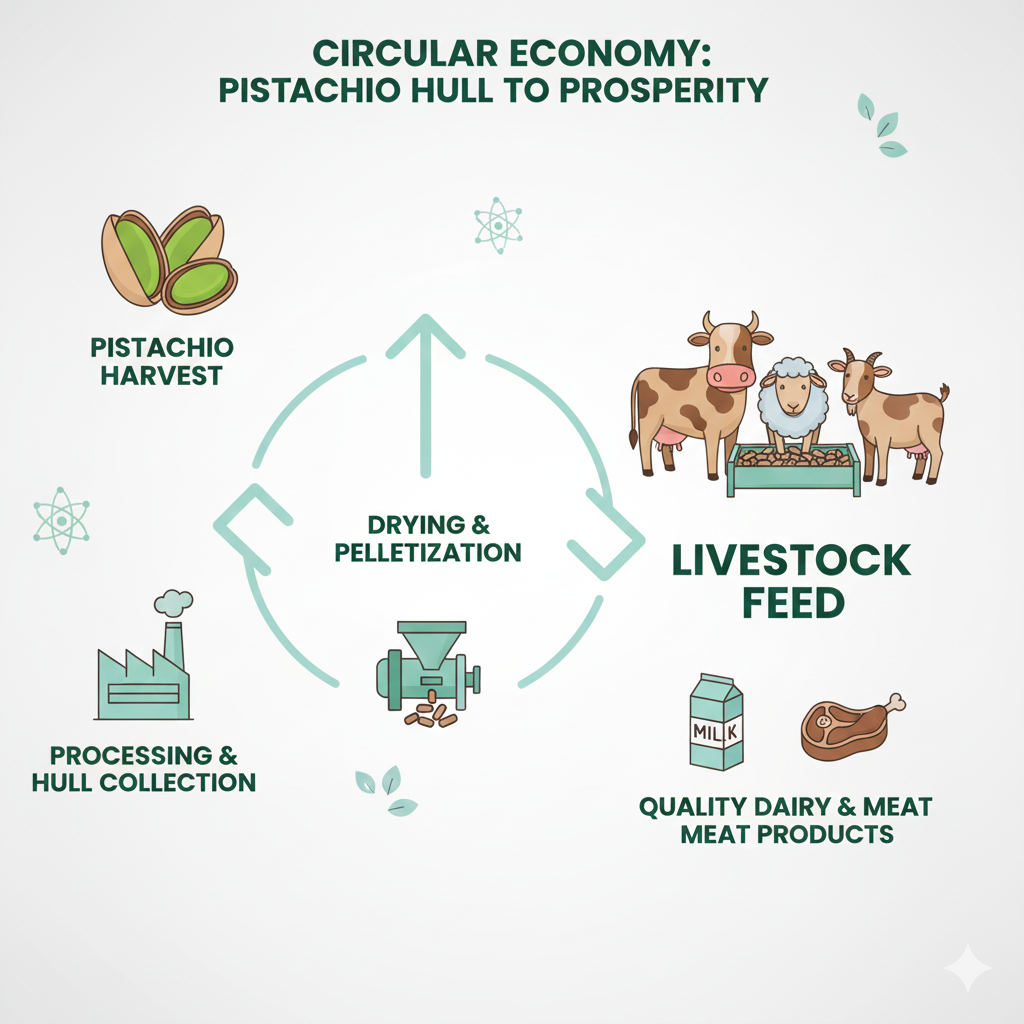
- Seasonality: Pistachio harvesting is highly seasonal (typically late summer/early autumn). This concentrated production requires large-scale infrastructure for rapid drying, efficient storage, and subsequent processing to ensure a year-round supply.
- Transportation Cost: Raw PH has a low Bulk Density. This translates to a significantly higher cost per unit of weight for long-distance transportation compared to dense concentrates.
- The Pelletization Solution: Establishing decentralized pelletizing plants strategically located near major processing hubs (e.g., Kerman Province) is the most critical logistical step. Pelletization dramatically increases bulk density, making inter-provincial transportation economically feasible and opening the national market for this valuable byproduct.
2.2. Standardization and Quality Assurance
For PH to be accepted by industrial feed mills and commercial livestock operations, rigorous quality control protocols are essential: - Aflatoxin and Mycotoxin Control: Strict control of moisture content (below 14%) is paramount to inhibit the growth of mold that produces mycotoxins (e.g., Aflatoxin B1), which are highly toxic to livestock and can contaminate the food chain.
- Pesticide Residue Monitoring: Regular testing for residual pesticides used in pistachio cultivation must ensure compliance with national and international feed safety standards.
- Economic Outlook and Policy Recommendations
The integration of PH is a matter of national economic strategy. Policy recommendations should focus on providing incentives for investment in PH processing technologies (pelletizing, alkaline treatment facilities) and supporting logistics companies specializing in byproduct transport. This strategic move will enhance food security and reduce the economic vulnerability of the domestic livestock industry to global feed market fluctuations.
Final Academic Summary: Pistachio Hull is a highly effective, low-cost fibrous feedstuff. Its success as a core component of sustainable livestock production depends on scientific management of its chemical complexities (especially tannins and lignin) and overcoming the logistical hurdles through capital investment in densification technologies. It represents a triple-win for the economy, environment, and producer profitability.
- Bulk Density Logistics
📞 Order Placement and Scientific Consultation
For bulk purchasing and placing orders for processed Pistachio Hull, or for professional consultation regarding the scientific inclusion rates in specific livestock diets, please contact Mr. Ravanshad via WhatsApp:- WhatsApp Contact: 00989214773705