

Secondary: Closed shell pistachios, Pistachio thermal shock, Aflatoxin risk in nuts, Iranian Pistachio export standards, Moisture content in pistachios.
Article Content:
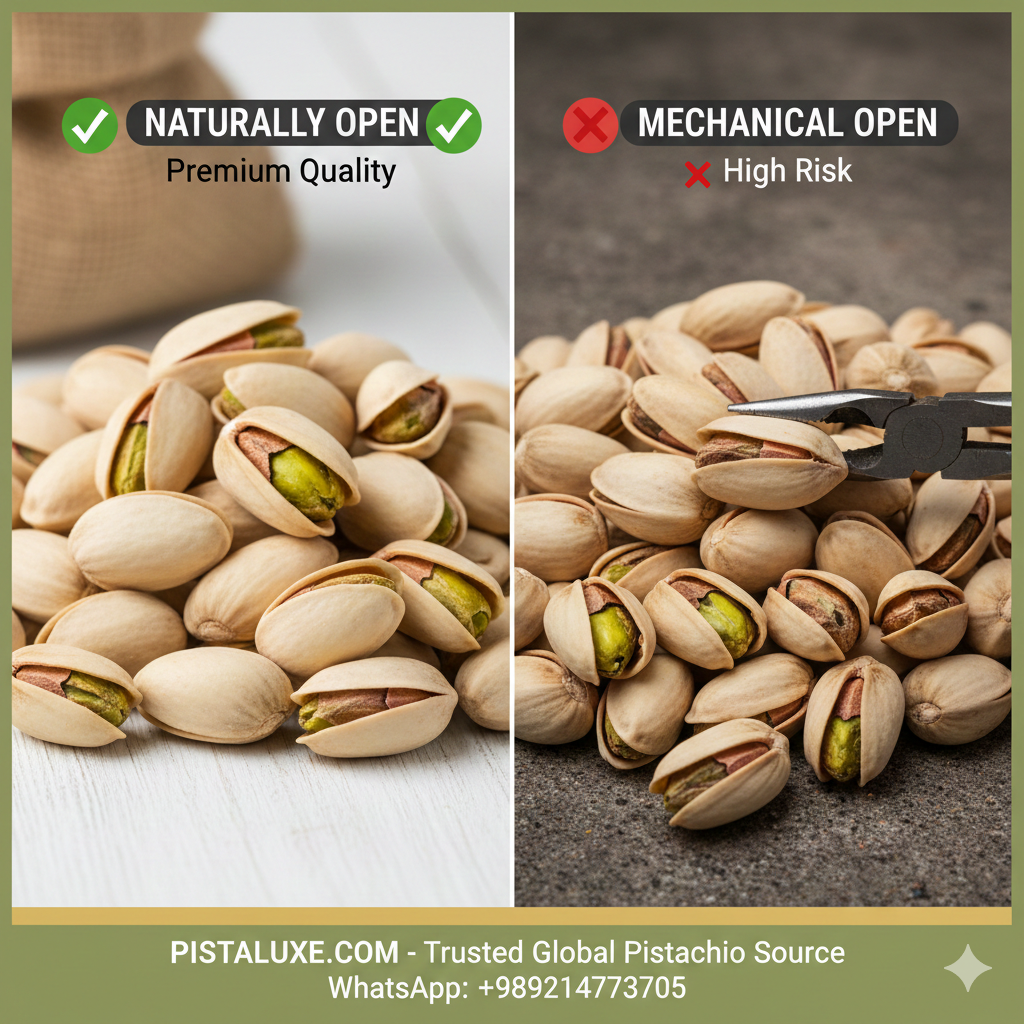
In the global nut industry, the distinction between Naturally Open (NO) and Mechanical Open (MO) pistachios is a critical factor that determines price, shelf life, and food safety. For bulk buyers and international importers, understanding the “thermal shock” process is essential to avoid low-quality shipments.
- The Physiological Process: Natural Splitting
A Naturally Open pistachio is the result of biological maturity. As the kernel (nut) grows inside the shell, it expands until it exerts enough internal pressure to split the hard endocarp (shell) along its natural suture. This process ensures that the kernel is fully developed, rich in oils, and possesses a robust flavor profile. - The Engineering of Mechanical Opening (Ab-Khandan)
Mechanical Open pistachios (locally known in Iran as Ab-Khandan) begin as “closed shell” pistachios. These are nuts where the kernel did not grow large enough to split the shell naturally. To make them marketable as “opened” nuts, they undergo a mechanical process:
- Hydration: The closed nuts are soaked in cold water for several hours until the shells become slightly pliable.
- Thermal Shock: The wet nuts are suddenly dropped into high-temperature industrial dryers. The rapid evaporation of water creates internal steam pressure that “pops” the shell open.
- Why Mechanical Open is Considered “Lower Grade”
From a research perspective, MO pistachios are inferior for three reasons:
- Kernel-to-Shell Ratio: Since they were originally closed shells, the kernels are smaller and less developed. You are paying for more shell weight and less nut meat.
- Oxidation and Rancidity: The soaking process introduces moisture into the kernel. Even after drying, the internal structure is compromised, leading to faster oxidation of fats and a shorter shelf life (usually less than 4 months).
- The “Rubbery” Texture: Unlike the crunchy texture of a Naturally Open pistachio, MO kernels often feel chewy or rubbery due to the artificial drying process.
- Identification Guide for Quality Controllers
- The “Click” Test: Try to press the two halves of the shell together. If the shell closes completely, it is almost certainly Mechanical Open. A naturally open shell will not close because the large kernel acts as a stopper.
- Visual Inspection: Look for “stress fractures” on the shell. MO pistachios often have jagged edges along the split rather than a smooth, natural curve.