

By Mr. Ravanshad
Founder, Pistaluxe | Qomes Tejarat Asia
In my two decades of moving Iranian pistachios into European ports, I have learned one uncomfortable truth: nobody in this industry buys pistachios. They buy certainty. The nut is the packaging; the product being traded is confidence.
There is a moment in every procurement cycle when a European buyer sits across from a supplier and asks the only question that truly matters: “What happens if your container fails at Rotterdam?” Every sales brochure in the industry promises “best quality.” Very few suppliers can answer that question with a documented system rather than an adjective. This section exists to make you the buyer who knows the answer, and to make the difference between a supplier and a partner impossible to ignore.
We will examine the single greatest technical risk in the Iranian pistachio trade — mycotoxin contamination — not as a scare story, but as an engineering problem with a measurable, manageable, and auditable solution chain.
1. Why Aflatoxin Is Not a “Quality Issue” But a Legal One
In the global pistachio trade, aflatoxin is frequently misdescribed as a quality defect. It is not. It is a regulatory threshold, and crossing it transforms your cargo from a commercial asset into a liability that you legally own the moment the bill of lading is issued.
Aflatoxins — principally Aflatoxin B1, the most toxicologically significant of the group — are secondary metabolites produced by Aspergillus flavus and Aspergillus parasiticus. These fungi are ubiquitous in warm, semi-arid agricultural zones. Their presence in the environment is unavoidable. Their presence in your finished lot is not.
The distinction matters enormously, because it defines where mitigation must happen:
| Contamination Stage | Mechanism | Where It Is Controlled |
|---|---|---|
| Pre-harvest | Soil-borne inoculum, insect-punctured hulls, drought stress | Orchard management |
| Harvest | Delayed picking, hull adhering to shell, ground contact | Harvest scheduling |
| Post-harvest | Slow hulling, wet stacking, inadequate drying | Processing plant discipline |
| Storage | Moisture migration, condensation, insect activity | Warehouse and transit control |
| Transport | Container sweat, temperature cycling | Logistics specification |
The critical insight: Aflatoxin is not created in the laboratory test. It is created — or prevented — in the first 48 hours after the nut leaves the tree. By the time a sample is drawn in Hamburg, the result was already written in the orchard and the hulling line. This is why supplier selection cannot be reduced to a price comparison.
2. The Regulatory Landscape: What Your Market Actually Demands
European buyers operate under the strictest mycotoxin regime on earth. Understanding it is not optional; it is the baseline of your compliance architecture.
European Union. Commission Regulation (EU) No 165/2010 sets maximum levels for pistachios intended for direct human consumption:
- Total aflatoxins (B1 + B2 + G1 + G2): 10 µg/kg
- Aflatoxin B1 alone: 8 µg/kg (Note: for pistardhios “ready to eat” the applicable B1 limit under the current consolidated framework is 8 µg/kg for total and 5 µg/kg for B1 — always confirm the figure that applies to your specific CN code and product presentation against the current consolidated text of Regulation (EC) 1881/2006 as amended, and against the latest EU Commission publication, because limits have been revised more than once and national enforcement practice varies.)
Additionally, the EU applies increased frequency official controls at border inspection posts on pistachios originating from Iran, meaning a defined percentage of consignments is subject to sampling and analysis before release into free circulation. Plan for it in your cash-flow model: a held container accrues demurrage, storage, and re-testing costs while your product is neither sellable nor lost.
Germany. BfR enforcement is rigorous and documentation-focused; ALTS (residue and contaminant) monitoring expectations are high, and German retail chains routinely impose contractual limits below the statutory ceiling — often 6 µg/kg total. Ask your customer for their internal specification, not just the legal one.
Italy. A mature processing industry with deep technical literacy. Italian importers frequently demand certificate of analysis per lot plus retained samples, and are highly sensitive to lot-to-lot variance rather than average compliance.
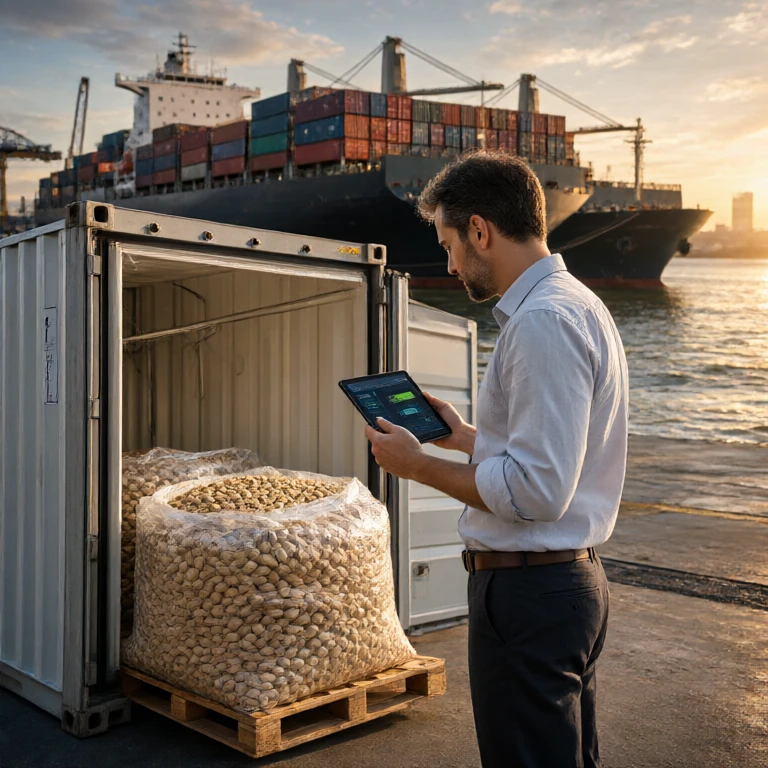
Netherlands / Rotterdam. The predominant entry gate for the North European trade. Expect intensive documentary and identity checks and a low tolerance for mismatches between commercial documents and laboratory results.
France. Strong traceability requirements under national implementation of EU food law; the “one step back, one step forward” principle is enforced in practice.
Codex Alimentarius. Provides the international reference framework (CXS 193-1995 and the Code of Practice for mycotoxin reduction), useful when negotiating with non-EU destinations or clarifying methodology disputes.
Practical translation for the buyer: A supplier who quotes a single flat aflatoxin figure (“under 10”) is signaling either inexperience or evasion. Serious exporters speak in terms of maximum level, per-lot distribution, sampling plan, and laboratory accreditation.
3. The Iranian Advantage — and the Reputational Burden
Let me address this directly, because no consultant will.
Iran produces pistachios of exceptional quality, and the sector has invested heavily in the last fifteen years in hulling-line modernization, optical sorting, and laboratory capacity. The country also carries, unfairly and persistently, a reputational discount in European procurement conversations — a legacy of enforcement actions from earlier periods and of high-profile border rejections that continue to be cited long after the underlying processes were reformed.
This discount is simultaneously:
- A risk — because buyers inherit the burden of proof through no fault of their own, and because a single failed consigment feeds a narrative with a long half-life; and
- An arbitrage opportunity — because regulatory-driven aversion compresses the price of Iranian product relative to its sensory and physical quality, for buyers who have built the technical infrastructure to verify what they purchase.
My position, stated plainly: the way to capture that arbitrage is not to argue about reputation. It is to out-document the competition. When a supplier can place in front of you a chain of custody from named orchard blocks to accredited laboratory results to container-seal numbers, the discussion stops being about nationality and starts being about specification. That is the only argument that survives a purchasing committee.
4. The Control Architecture: Nine Gates Between Orchard and Port
Below is the control architecture I recommend to every serious buyer, and the one I operate against. Treat it as an audit checklist; a supplier who cannot speak to each gate has gaps you are financing.
Gate 1 — Orchard Selection and Block Traceability
Cultivation is registered against specific orchard blocks, not aggregated “villages.” Irrigation source, previous crop, and adjacent crop history are documented. Blocks with a history of Aspergillus pressure are excluded from export lots regardless of visual quality.
Gate 2 — Harvest Discipline
Picking is scheduled on maturity and moisture, not on labor availability. The single highest-leverage variable in the entire chain is the interval between the nut reaching the ground and the hull being removed. Every hour of delay in warm conditions multiplies fungal proliferation risk.
Gate 3 — Hulling and Washing Protocol within four hours
Mechanical hulling, followed by immediate washing in potable water, followed by forced-air drying. “Wet stacking” — the practice of holding hulled nuts in bulk waiting for drier capacity — is the classic root cause of otherwise inexplicable lot failures. Ask how many hours, and ask for the log.
Week 4 — Controlled Drying to Critical Moisture
Drying to a target moisture (commonly 4–5% for safe storage of in-shell) with continuous temperature monitoring. Over-drying causes kernel shrivel and split damage; under-drying guarantees further mold growth in transit. The acceptable window is narrow, and it requires instrumentation, not experience.
Gate 5 — Mechanical and Optical Sorting
Destheiing, air-gravity separation, color sorting, and increasingly X-ray and laser sorting for internal defects that vision systems cannot see. Optical sorting removes detectable visual defects; it does not remove invisible mycotoxin — which is precisely why sorting is a mitigation, never a guarantee.
Gate 6 — Laboratory Testing with a Defensible Sampling Plan
The statistically weakest link in most supply chains is the sampling plan. A 20 kg composite sample drawn from a 20-tonne lot can, in bad plans, produce a result that is comfortable and unrepresentative.
Best practice demands:
- Incrementation from multiple positions across the lot volume, not a surface grab;
- Aggregated composite testing (a high number of incremental samples combined into one laboratory sample), consistent with EU Regulation 401/2006 sampling methodology;
- Accredited laboratories operating under ISO/IEC 17025, with HPLC-FLD or LC-MS/MS methodology — not rapid screening strips as a sole basis for release;
- Retaliatory sample retention at the supplier’s facility, sealed and identified by lot, retained for a defined period, available to a third party.
Gate 7 — Segregated Storage
Approved lots stored physically separated from unapproved or uncleared lots, with lot identifiers that survive every movement. A warehouse that cannot prove segregation cannot prove which nut is which — and in an audit, that is a finding.
Gate 8 — Pre-Shipment Verification and Seal Integrity
Final lot verification, container cleanliness inspection, moisture-barrier liner specification, desiccant where appropriate, and a numbered high-security seal whose number appears on the bill of lading and the packing list. Container sweat during long sea transit is a documented contamination vector; the packaging and liner specification is part of your risk purchase.
Gate 9 — Independent Third-Party Inspection
Schiavo/load-port inspection by an internationally recognised body (SGS, Bureau Veritas, Cotecna, or equivalent), with analysis drawn and sealed under supervision. This costs a fraction of a percent of consignment value and is the single most persuasive document you can place before your own quality assurance department.
5. Reading a Certificate of Analysis Like a Procurement Professional
A CoA is not a validation stamp. It is a data structure, and most buyers read it wrong. Here is the audit I run on every document:
| Element | What to Verify | Red Flag |
|---|---|---|
| Laboratory identity | ISO/IEC 17025 scope covers mycotoxins in nuts | Scope certificate not produced |
| Sampling method | Incremental/composite, sample mass stated | “Sample from consigment” with no plan |
| Method of analysis | HPLC-FLD or LC-MS/MS with LOQ stated | Screening-only or method omitted |
| Result vs. LOQ | Result expressed against a valid quantification limit | “<10” reported with LOQ of 10 |
| Lot identification | CoA lot number matches packing list and seal | Number drift between documents |
| Date chain | Sampling date, receipt date, report date all coherent | Sampling predates production |
| Moisture and count | Stated alongside mycotoxin figures | Contradictory physical data |
Two further disciplines that separate experienced importers from exposed ones:
Insure against variance, not averages. Contract for maximum acceptable limits with defined consequences for breach — and define consequence in operational terms (replace, re-process at supplier cost, or credit), not in goodwill language. A contract that says “best quality” is decoration.
Build an arrival-testing routine. Draw your own sample on arrival per a written plan; store it sealed; compare against the supplier’s CoA. Over three or four containers, you will know precisely how much to trust that supplier’s data — and that knowledge, not the price list, is your negotiating leverage. It also gives you the only thing that matters if a dispute arises: evidence with a chain of custody of your own.
6. The Commercial Mathematics of Quality Failure
Buyers habitually compare suppliers on landed cost per kilogram. That metric is incomplete without a risk-adjusted cost that prices the failure scenario.
Consider a 20-tonne container of in-shell pistachios. A rejected consignment under EU border controls may trigger:
- Demurrage, port storage, and inspection fees accrued during detention;
- Laboratory re-testing and, in some jurisdictions, destruction or re-export charges;
- Financing cost of capital tied up in unsellable inventory for the duration of the dispute;
- Contractual penalties with your downstream customer, often exceeding the goods’ margin;
- Replacement logistics on compressed timelines at spot freight rates;
- The unquantifiable cost of an entry in the EU’s Rapid Alert System for Food and Feed (RASFF), which is publicly searchable and visible to every counterparty who searches your company or your supplier.
A supplier whose price is 4% lower but whose documentary and processing discipline is unverifiable is not cheaper. It is leveraged. You are being paid 4% to underwrite an exposure of perhaps 60–100% of consignment value. In risk terms, that is an extraordinarily poor trade — and it is the trade most of the market is quietly making.
The rule I give every new counterparty: Never negotiate the price of a commodity until you have agreed the price of a failure. Quality architecture is not a cost line. It is the structure of the transaction.
7. Where Aflatoxin Risk Inters national Segmentation — Caps and Scenarios
There is no single safe profile across all pistachio presentations. Risk behaves differently by product form, and formulating by presentation is essential:
- In-shell lots generally carry lower measured aflatoxin concentrations than kernels from the same batch, because the shell acts as a partial barrier and particles carrying concentrated toxin are more dispersed in kernel processing streams. However, visibly stained or damaged shells are an indicator requiring segregation.
- Kernels present the highest concentration risk because the protective barriers are removed and any localized contamination is homogenized into the lot during sizing and handling. Kernel buyers need a stricter regulatory specification, not the same one.
- Diced and crushed product multiplies surface area, mixing, and homogenization — the safest commercial structure is specification-by-lot with retained samples at each particle-size grade.
- S lip lids / splits may expose kernel earlier and require tighter harvest timing.
- Organic and EU-organic certified streams face additional certification constraints and shorter permitted substance lists, and are worth confirming in every technical conversation.
Also note — and this is the sentence most suppliers would prefer I deleted — cleaning and sorting can reduce measured toxin but cannot be relied upon to remediate an already-contaminated lot. A supplier who offers to “re-clean a failed lot” is describing a gamble with your brand name on it. The only reliable intervention is upstream prevention.
8. Building the Buyer’s Due-Dilegence File
When you receive a technical dossier from Pistaluxe, it contains, by design, the following, and you should demand no less from any counterparty:
- Company registration and export licensing documentation;
- Named facility list with capacities, hulling line specifications, and dryer capacities;
- Orchard block registry and grower agreements;
- Sampling protocol, written, in English, per EU methodology;
- Accredited laboratory names, scopes, and typical turnaround;
- Five consecutive lots of CoA history — not a “typical” certificate;
- Segregation, storage and fumigation protocols;
- Packaging and container-liner specifications;
- A written quality complaint and claim procedure with time limits;
- References from buyers in your own market and product category.
If a quotation arrives without the ability to produce at least eight of these ten items within a business week, treat the quotation as a price indication, not an offer.
9. The Certification Landscape: What to Actually Ask For
Certification is a tool, not a personality. Many suppliers display badges on their websites as decoration; procurement professionals read them as operational boundaries. Here is how to evaluate the certifications that actually matter in European B2B pistachio trade:
- ISO 22000 & HACCP: The baseline of food safety management. HACCP (Hazard Analysis Critical Control Point) is non-negotiable; if a packing facility cannot produce a valid, audited HACCP flow diagram covering their hulling and sorting lines, walk away. ISO 22000 confirms that the management system is third-party audited, but always verify the scope—ensure it covers nut processing and sorting, not just general warehousing.
- IFS (International Featured Standards) / BRCGS (British Retail Consortium Global Standards): These are the gold standards for European retail and industrial supply. A facility holding a BRCGS (Grade A or AA) or IFS certification has subjected itself to unannounced or rigorous annual audits that mirror the demands of major European supermarkets. Sourcing from a BRCGS/IFS-certified packer drastically reduces your internal audit burden.
- GlobalG.A.P. (Good Agricultural Practice): Focuses on the upstream agricultural phase—orchard management, water usage, chemical application, and worker welfare. For buyers targeting sustainability-conscious European brands, origin traceability backed by GlobalG.A.P. is a powerful commercial differentiator.
- Halal & Kosher: Essential certifications depending on your downstream client base, requiring verified supply chain segregation and approved ingredient integrity.
- Organic (EU Regulation 2018/848): If you are importing organic pistachios, demand the specific Transaction Certificate (TC) linked to the EU Trade Control and Expert System (TRACES) for every single consignment. An organic certificate for the packer is useless without a traceable TC for the specific lot.
The golden rule of documentation: Never accept a certificate based on its logo. Ask for the certificate number, the issuing body (accredited by an IAF member), the exact operational scope, and the validity dates.
Conclusion
In the export of premium Iranian pistachios, risk is not eliminated by luck; it is engineered out of the supply chain through rigorous documentation, defensible sampling, and absolute transparency. When you partner with a supplier who treats aflatoxin compliance and quality gates as a science rather than an afterthought, the historical reputational hurdles of the origin disappear behind verifiable data.
In Part IV, we will examine Logistics, Cold Chain Integrity, and European Port Entry Dynamics — exploring how to navigate maritime shipping, container sweating, customs clearance at Rotterdam and Hamburg, and how to protect your margins from unexpected demurrage costs.
📞 Connect with Us Directly…
Direct WhatsApp/Call: +98 921 477 3705 | Professional Email: info@pistaluxe.com | Official Website: pistaluxe.com