

📜 Introduction: Narratives of Two Legacies
In the world of nuts, few products possess the history and cultural identity of the pistachio. This “Green Gold,” once exclusive to Persian royal courts, now embodies two dominant global narratives: the story of authenticity, tradition, and Terroir from Iran, and the tale of modernity, scalability, and branding from California. This article seeks not merely to present statistical comparisons but to explore the deep cultural, flavor, and processing differences that define the unique identity of each product on the global stage.
☀️ The Iranian Terroir: The Handiwork of Climate and Soil
What defines the flavor of Kerman or Rafsanjan pistachios has been shaped over thousands of years not just by genetics, but by Iran’s distinct Terroir. Iranian pistachios thrive in a harsh, arid, desert climate characterized by extreme temperature fluctuations between day and night, coupled with specific mineral and salt content in the desert soils. This challenging environment forces the plant to produce higher concentrations of essential oils and aromatic compounds for survival.
The result is a pistachio characterized by richer fat content, deeper flavor, and greater aromatic complexity. These qualities are often described by international chefs and food experts as “nuttier,” “warmer,” and having a more pronounced, lingering taste. This inherent intensity makes the Iranian variety ideal for traditional uses and heavy Persian sweets, where the flavor must stand out amongst other powerful ingredients.
In contrast, Californian pistachios, primarily derived from Iranian cultivars like Kerman, are cultivated in a more controlled environment with rich soils and managed irrigation. This contributes to uniformity in size, a brighter green color, and a milder, slightly sweeter flavor profile. These traits make the Californian nut highly suitable for large-scale food manufacturing, use in processed snacks, and as a standardized, predictable ingredient.
🔥 Processing: The Divide Between Hand-Crafted Tradition and Industrial Standard
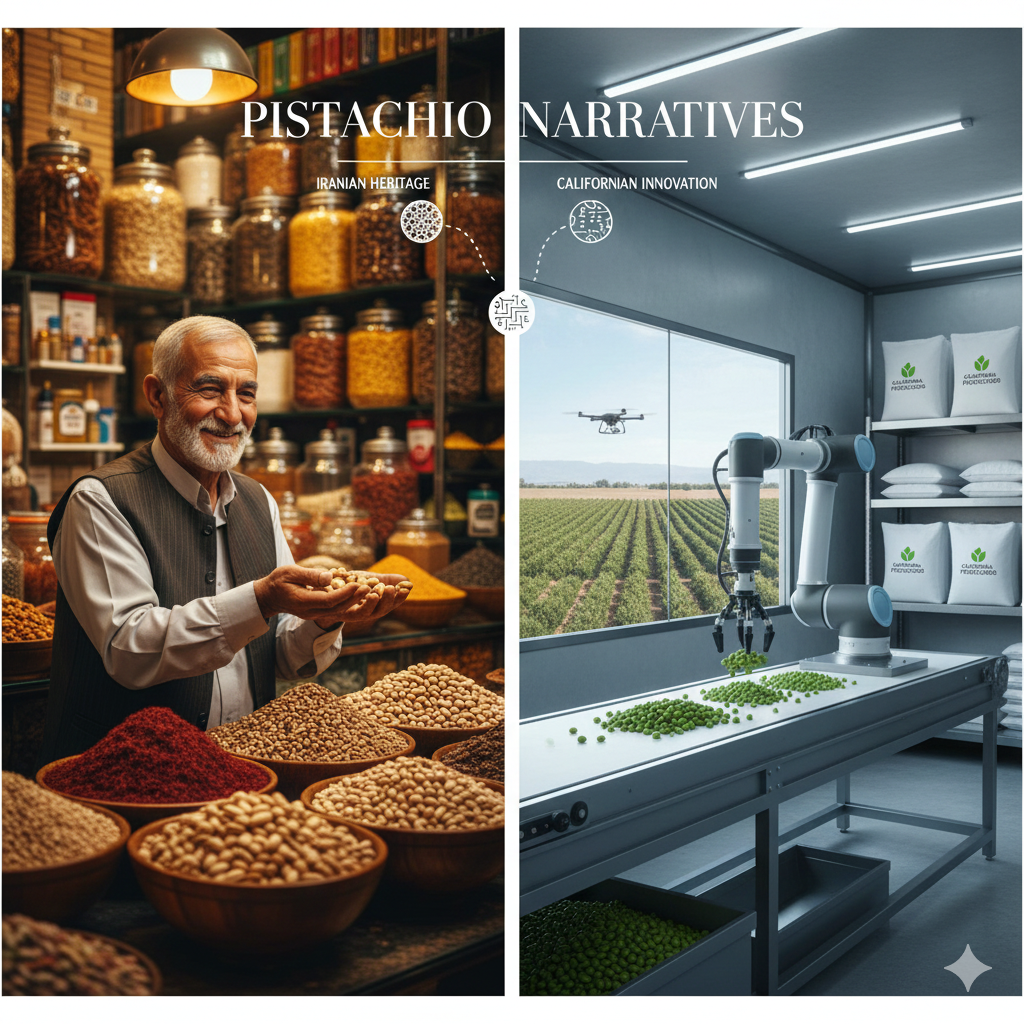
Pistachio processing in both regions is a mirror reflecting their overall approach to production. In Iran, processing often relies on traditional and semi-industrial methods. Sun-drying and simple roasting with salt, saffron, or lime juice are techniques primarily aimed at preserving the natural flavor and texture of the kernel. While these methods may lack industrial efficiency, they produce a wider variety and greater depth of flavor, cementing the pistachio’s role in traditional Iranian hospitality and cuisine.
California’s approach is a fully automated, industrial operation built on strict food safety standards, especially concerning Aflatoxin control. They utilize modern thermal roasters and sophisticated laser sorting systems for shelling, roasting, and packaging. The core focus is on uniformity, long shelf-life, and high-volume output. This process results in a standardized, clean product with minimal moisture, making it ideal for large-scale export and extended retail display.
🛒 Market Identity: Cultural Authenticity vs. Health-Focused Branding
The difference in market approach is perhaps the deepest cleavage. The Iranian pistachio is globally recognized as a commodity characterized by historical authenticity and superior flavor quality. Exports are typically done in bulk to intermediate markets and processing centers. The marketing narrative, though often implicit, revolves around heritage, powerful flavor, and its role in cultural celebrations.
Conversely, the Californian pistachio is built on modern Consumer Branding strategies. The focus is on retail packaging, attractive branding, and direct sales to the consumer. Their marketing message explicitly emphasizes convenience, being a great source of protein, heart health benefits, and high production safety (particularly important in Western markets). This product aligns perfectly with the fast-paced lifestyle and science-backed nutritional focus of contemporary consumers.
Ultimately, despite facing structural and logistical processing challenges, the Iranian pistachio carries a cultural and flavor richness that distinguishes it from its industrial competitor. These two products are not adversaries, but complements, addressing different needs in the global market: one for profound, authentic flavor, and the other for convenience, standardization, and health emphasis.
For purchase and order registration on WhatsApp:
Mr. Ravanshad: 00989214773705