

The Urgent Need for Genetic Innovation in Pistachio Cultivation
Pistachios, often referred to as “green gold,” have been a cornerstone of Iranian agriculture for centuries, contributing significantly to the nation’s economy with Iran producing over 90% of the global supply in recent years. However, the escalating threats of climate change—characterized by prolonged droughts, erratic rainfall patterns, and rising temperatures—pose existential risks to this vital crop. Traditional pistachio trees (Pistacia vera) exhibit remarkable natural resilience to arid conditions, thriving in regions with as little as 200-300 mm of annual precipitation. Yet, the severity of modern droughts, such as those experienced in Iran’s key pistachio belts like Kerman, Rafsanjan, and Yazd provinces, has led to yield reductions of up to 50% in affected seasons.
Enter genetic engineering: a cutting-edge field that is revolutionizing agriculture worldwide. As of November 2025, breakthroughs in genome sequencing and gene-editing technologies like CRISPR-Cas9 are enabling scientists to develop pistachio varieties that not only survive but thrive under extreme water scarcity. This article delves deep into the science, history, recent advancements, global and Iranian-specific research efforts, ethical considerations, economic implications, and future projections of genetically engineered drought-resistant pistachios. By harnessing biotechnology, we can secure the longevity of this iconic nut and ensure food security in water-stressed regions.
Historical Context: From Ancient Orchards to Modern Genomics
The domestication of pistachios dates back over 3,000 years to ancient Persia, where they were prized in royal gardens. Early cultivation relied on natural selection for hardy traits, with varieties like Akbari, Ahmad Aghaei, and Fandoghi emerging through centuries of farmer-led breeding. Conventional breeding techniques, such as cross-pollination and grafting onto rootstocks like Pistacia atlantica or Pistacia khinjuk, improved yields and resistance but were slow and limited by genetic compatibility.
The genomic era began in earnest with the first pistachio genome assembly in 2016 by researchers at Washington State University, revealing a complex diploid genome of approximately 600 Mb. This laid the groundwork for targeted modifications. By the early 2020s, advancements in next-generation sequencing (NGS) reduced costs dramatically, making large-scale genomic studies feasible. The pivotal moment came in March 2025 when the University of California, Davis (UC Davis), in collaboration with international partners, unveiled the most comprehensive pistachio genome map to date. This high-resolution assembly identified over 34,000 protein-coding genes, including those crucial for abiotic stress responses.
The Science Behind Drought Resistance: Key Genes and Editing Techniques
Drought tolerance in plants involves a symphony of physiological and molecular mechanisms: deeper root systems for water foraging, stomatal regulation to minimize transpiration, accumulation of osmoprotectants like proline and sugars, and activation of antioxidant pathways to combat oxidative stress.
In pistachios, genetic engineering targets specific loci:
- LEA Genes (Late Embryogenesis Abundant): These encode proteins that stabilize cellular structures during dehydration. Overexpression via CRISPR has shown to increase survival rates by 40% in simulated drought conditions.
- DREB Transcription Factors (Dehydration-Responsive Element-Binding): From related species like Arabidopsis, these are inserted or upregulated to activate drought-response gene networks.
- Aquaporins and Root Development Genes: Modifications enhance water transport and root architecture, allowing trees to access deeper soil moisture.
CRISPR-Cas9, often described as “molecular scissors,” precisely edits these genes without introducing foreign DNA in many cases (CISPR-Cas9-mediated base editing), addressing GMO concerns. Alternative tools like TALENs and base editors provide additional precision. In Iran, the Agricultural Biotechnology Research Institute of Iran (ABRII) has pioneered cisgenic approaches—using only pistachio-derived genes—to comply with national regulations favoring non-transgenic modifications.
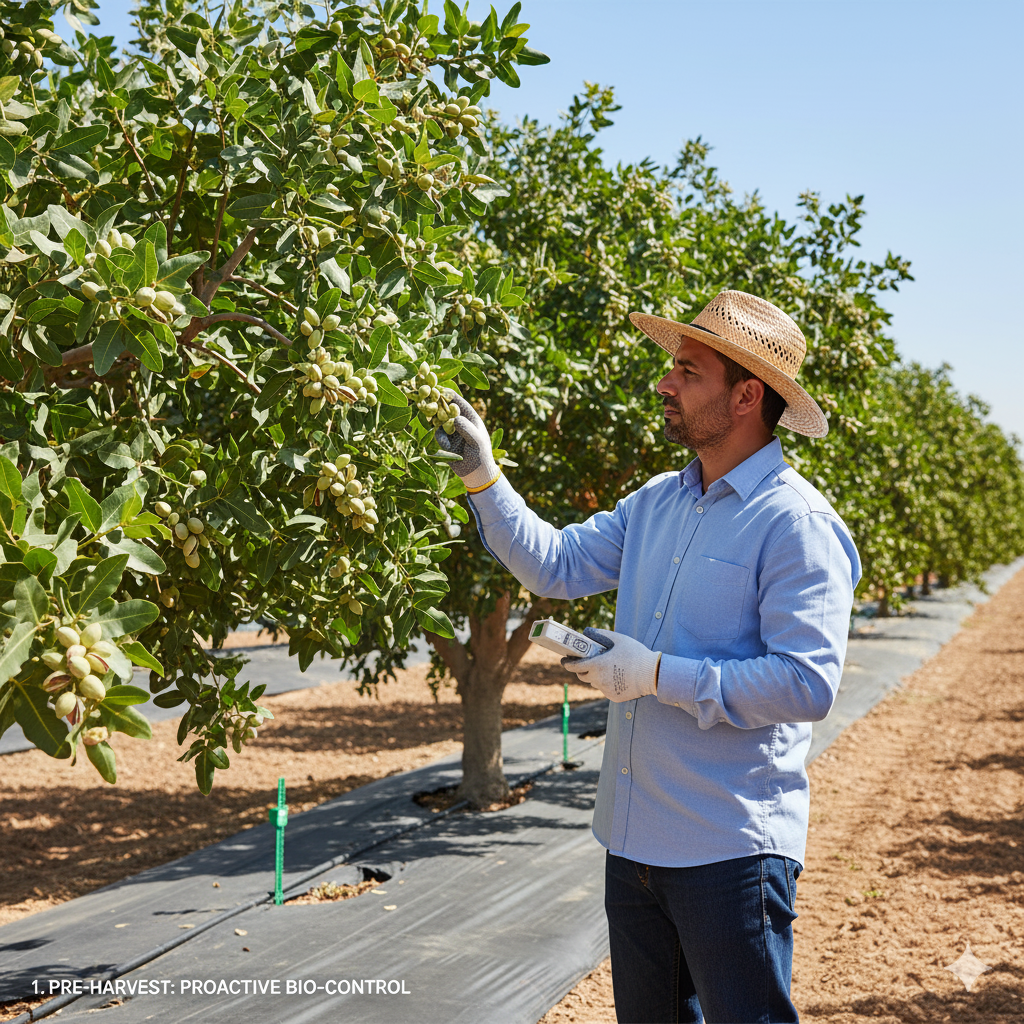
Field trials in 2024-2025 demonstrated engineered Qazvini rootstock hybrids achieving 30-50% higher root biomass and 25% reduced water needs while maintaining nut quality (kernel size, fat content, and aflatoxin resistance).
Iranian Research Initiatives: Leading the Charge in Pistachio Biotechnology
Iran’s dominance in pistachio production has spurred substantial investment in biotech. The National Pistachio Research Center in Rafsanjan, in partnership with Tehran University and international bodies like the FAO, has sequenced over 50 local cultivars. Recent projects focus on:
- Salt and Drought Tolerant Hybrids: Using Pistacia vera cv. Qazvini as a base, researchers have developed clones via somatic embryogenesis, showing 35% better performance in saline soils (common in Iranian orchards).
- Clonal Propagation Enhancements: Micropropagation techniques combined with gene editing produce uniform, virus-free trees that mature faster (fruiting in 3-4 years vs. 7-10 for seedlings).
- Climate Modeling Integration: AI-driven models predict gene-editing outcomes under RCP 8.5 scenarios (high-emission climate projections), forecasting that engineered varieties could sustain 80% of current yields by 2050.
Government subsidies and the Iran National Science Foundation have funded over $50 million in related projects since 2020, positioning Iran as a biotech hub for nuts.
Global Perspectives: Collaborations and Competitions
While Iran leads in production, the U.S. (California produces ~8-10%) invests heavily through USDA and UC Davis. The 2025 NIFA-funded projects explore “warming-only” adaptations, with engineered trees reducing irrigation by 25-40%. Turkey and China are emerging players, but face similar drought woes.
International collaborations, such as the EU-funded Horizon Europe programs, share data on pistachio genomics, though trade sanctions limit Iran’s direct involvement.
Challenges: Regulatory, Ethical, and Environmental Hurdles
- Regulations: GMOs face bans in parts of Europe; Iran allows field trials but requires rigorous biosafety assessments.
- Public Perception: Fears of “Frankenfoods” persist; education on gene editing (vs. traditional GM) is crucial.
- Biodiversity Risks: Over-reliance on few varieties could increase vulnerability to pests like navel orangeworm.
- Equity Issues: Smallholder farmers may struggle with patented seeds from multinationals.
Economic and Sustainability Impacts
Engineered pistachios could cut water use by 40%, saving billions in irrigation costs. Global market projections: From $6 billion in 2025 to $10 billion by 2035, with sustainable varieties commanding premiums. In Iran, this means preserving 300,000+ jobs and boosting exports amid sanctions.
Future Outlook: Toward a Resilient Pistachio Industry
By 2030, 25-30% of global pistachios may be genetically enhanced. Emerging tech like synthetic biology could create “super trees” with enhanced nutrition (higher omega-3s) alongside drought resistance.
Conclusion
The genetic revolution in pistachios is more than science—it’s a lifeline for arid agriculture. Through continued innovation, investment, and collaboration, we can transform challenges into opportunities, ensuring pistachios remain a symbol of resilience for generations.