

Author: Mr. Ravanshad
Company: Pistaluxe (Qomes Tejarat Asia)
Reading time: ~9 minutes | Audience: B2B Importers, Confectionery, Gelato & Chocolate Manufacturers, Roasters, Private-Label Brands
Introduction: A Comparison Buyers Actually Make Every Season
Every year, procurement managers across Europe face the same quiet question before locking in their raw material contracts: should we buy Iranian pistachios or American pistachios?
The answer is not ideological and it is not about “which country is better.” It is a technical and commercial question with a clear structure once you break it into five dimensions: flavour and aroma profile, available varieties and kernel yield, price structure and landed cost, food safety and regulatory reality, and supply timing and logistics.
This guide walks through each one honestly, including where each origin wins — and where the safest strategy is a mixed portfolio.
1. Flavour and Aroma: The Most Underrated Cost Variable
For manufacturers of pistachio paste, gelato, baklava, nougat, and premium chocolate inclusions, flavour is not a “nice to have” — it is the product.
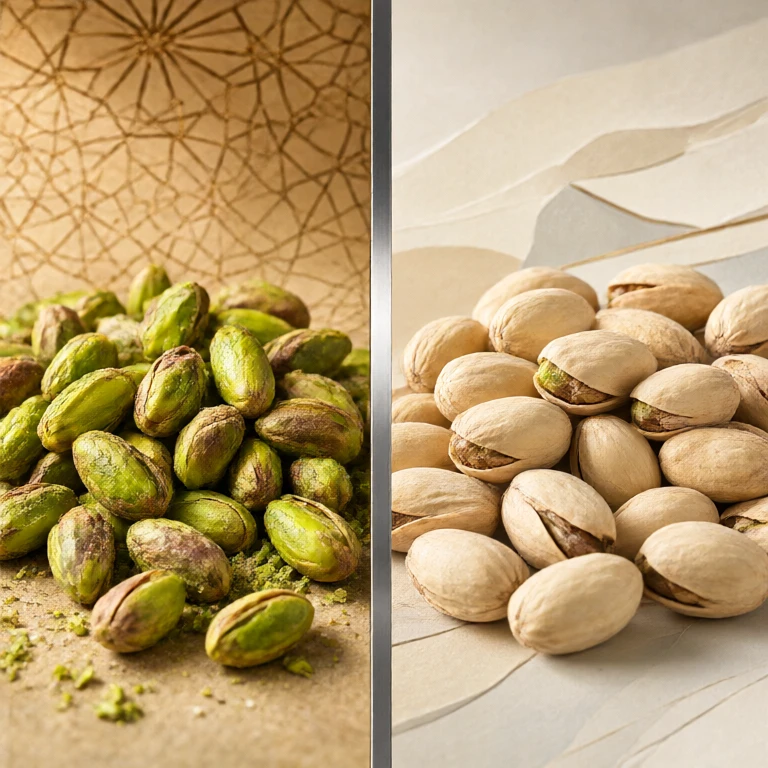
Iranian pistachios are widely recognized in the trade for a deeper, more aromatic, slightly sweeter and more complex flavour. This is a direct consequence of the terroir in Kerman and Rafsanjan: mineral-rich soil, intense sunlight, and low humidity during kernel development. Varieties such as Akbari, Ahmad Aghaei, and Kalleh Ghouchi carry a distinctive roasted aroma that survives processing and is valued in Mediterranean and Middle Eastern confectionery traditions.
American pistachios (primarily from California) are consistent, clean-tasting, and milder. Their uniform cultivation and industrial processing make them an excellent fit for products where the pistachio is a background note rather than the star ingredient.
Practical takeaway: Higher-value applications where pistachio is the hero flavour — paste, gelato, premium confectionery — typically reward Iranian origin’s aroma. Applications where consistency and neutral flavour matter more — snack mixes, mass-market roasting — can justify American origin.
2. Varieties, Sizing, and Kernel Yield
This is where Iran’s advantage is structural, not just sensory.
| Dimension | Iranian Pistachios | American Pistachios |
|---|---|---|
| Commercial varieties | Akbari, Fandoghi, Ahmad Aghaei, Kalleh Ghouchi, Badami | Predominantly Kerman |
| Size range | Very broad — 18/20 to 30/34 counts | Narrower, concentrated in large sizes |
| Shell colour | Natural creamy beige (no bleaching required) | Naturally lighter shell |
| Kernel flavour depth | High | Mild |
| Availability as derivatives | Kernels, paste, butter, flour, powder, oil | Mainly whole & kernels |
For a chocolate manufacturer, Akbari offers an elongated, elegant visual profile with strong kernel-to-shell ratio. For baklava and paste production, Fandoghi delivers reliable volume economics. For premium gifting and gourmet retail, Kalleh Ghouchi is a signature Iranian offering with almost no direct American substitute.
American supply, by contrast, is essentially centred on one variety — which means when Kerman sizing or pricing shifts, buyers have limited alternatives within the same origin.
3. Price Structure and Landed Cost
Comparing headline FOB prices between origins is a classic procurement error. The correct metric is landed cost per usable kilogram of finished product.
Three Iranian advantages are frequently overlooked:
- No bleaching cost. Iranian pistachios are sold with natural shell colour; bleaching adds processing cost, regulatory scrutiny, and flavour loss.
- Derivative availability at origin. Buying paste, butter, and flour from the same Iranian supply chain reduces freight volume, duty on shell waste, and processing overhead in Europe.
- Shorter freight to Europe. Bandar Abbas to Northern European ports is a comparatively short sea leg versus US West Coast routes, reducing transit risk and inventory holding cost.
At the same time, US pricing is more transparent and futures-adjacent, which some corporate procurement departments prefer for budget predictability. Iranian pricing depends more on harvest size, currency dynamics, and export policy — which is why a supplier with direct farmgate access and component-based quoting is essential.
4. Food Safety and the Regulatory Reality (Read This Carefully)
Both origins operate under the same EU legal framework, but their border control exposure differs at any given time.
- All pistachios entering the EU must comply with Commission Regulation (EU) 165/2010 on maximum aflatoxin levels: 8 µg/kg total aflatoxins and 2 µg/kg aflatoxin B1 for pistachios intended for direct human consumption.
- Iranian pistachios have historically been listed under Commission Implementing Regulation (EU) 2019/1793, which imposes increased official controls — typically a 10% frequency of physical and identity checks plus a certificate accompanied by sampling and analysis results. The listing is reviewed and updated periodically; what matters for your business is that your supplier can consistently produce sampling according to EU Regulation 401/2006 and ISO/IEC 17025-accredited laboratory certificates of analysis.
- American pistachios are subject to the same aflatoxin limits but generally face standard documentary and random verification at the border.
For a European buyer, the Iranian-origin listing is not a barrier — it is a documentation discipline test. A serious Iranian exporter treats EU-compliant sampling and accredited CoAs as standard operating procedure, not as a special favour.
5. Supply Timing, Logistics, and Seasonality
The two origins run on different calendars:
- Iranian harvest: late August to October, with new-crop availability peaking from October through December.
- American harvest: September to October, with new-crop offers arriving in Europe from November onwards.
For European manufacturers planning Q1 production, this means Iranian supply is typically available and priced earliest after harvest — a structural advantage for buyers who plan their procurement calendar around the actual crop, not the calendar year.
6. So Which Should You Choose? A Decision Framework
| Your situation | Recommended approach |
|---|---|
| Paste, butter, gelato, premium confectionery | Iranian (Akbari, Ahmad Aghaei, Kalleh Ghouchi) |
| Baklava, large-volume bakery use | Iranian Fandoghi with strict sizing specs |
| Mass-market snack roasting | American or Iranian large-size depending on landed cost |
| Need for maximum price predictability | Mixed portfolio — hedge with US origin |
| Desire for derivative format at origin | Iranian (paste/butter/flour/powder available) |
| Strict “single-origin only” policy | Whichever origin you can document most reliably |
The most resilient European buyers we work with do not pick one origin forever. They run a portfolio: Iranian origin for flavour-critical, high-margin SKUs and American origin as a buffer for volume SKUs and price stability.
7. Where Pistaluxe Fits
Pistaluxe (Qomes Tejarat Asia) supplies the Iranian side of that portfolio with the technical discipline European buyers require:
- Direct farmgate-to-factory integration in Kerman and Rafsanjan, eliminating broker layers.
- Four varietal streams — Akbari, Fandoghi, Ahmad Aghaei, Kalleh Ghouchi — with calibrated sizing and split tolerances.
- Derivative capability at origin: paste, butter, flour, powder, and oil.
- EU-compliant documentation and accredited analysis as a standard, not an exception.
- Direct English communication with Mr. Ravanshad, with batch-level traceability from orchard to port.
If you are re-evaluating your origin mix for the next season, we can provide comparable specifications and landed-cost calculations so your decision rests on numbers rather than assumptions.
📞 Connect with Us Directly
- Direct WhatsApp / Call: +98 921 477 3705
- Professional Email: info@pistaluxe.com
- Official Website: pistaluxe.com