

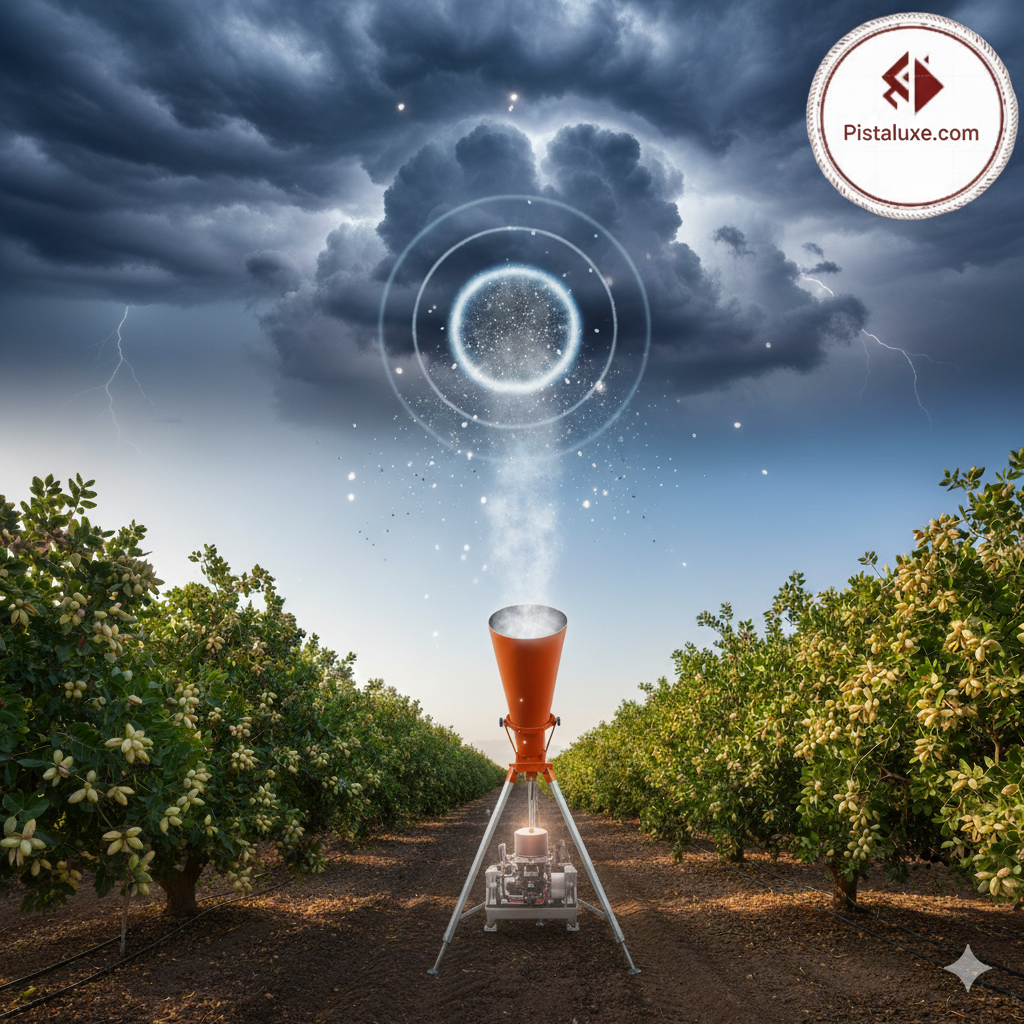
The scientific debate surrounding the definitive impact of acoustic shock waves on atmospheric systems continues. This paper adopts a deep scientific-research approach to investigate the physical and chemical effects of these waves on the microstructure of water and ice particles within the core of hailstorms. Advanced modeling suggests that the shock wave energy, by creating an instantaneous pressure front, may provide the necessary energy for the mechanical fracture of large ice crystals or disrupt the freezing process of supercooled water droplets through a phenomenon known as Acoustic Cavitation. The primary objective is to develop a scientific framework that leads to recommendations for optimizing device parameters (including fuel mix, firing frequency, and emission angle) to maximize the protective effect within the altitude and coverage range relevant to pistachio tree canopy.

2. Physical Mechanisms of Shock Wave InterventionThe shock waves generated by these devices possess two principal components—pressure and frequency—that are postulated to influence cloud dynamics simultaneously:2.1. Instantaneous Pressure EffectThe shock wave travels supersonically, creating an abrupt pressure change. This pressure differential is hypothesized to: * Induce Mechanical Fracture: The shear forces resulting from the pressure gradient across large ice crystals could cause them to shatter into numerous smaller, less damaging fragments that fall harmlessly. * Disrupt Updraft Paths: At a high firing frequency, the sudden energy release might locally interfere with the main updraft currents within the cloud, potentially dispersing the hail-forming zone.2.2. Acoustic Cavitation EffectIn regions containing supercooled water droplets, high-power acoustic waves may cause the formation and immediate collapse of vapor bubbles—the process of Cavitation. The energy released by this collapse could disrupt the freezing kinetics of supercooled droplets, maintaining them in a liquid state for longer periods, leading to rain rather than hail.
3. Optimization of Device Parameters for Pistachio Orchards 🔧To ensure the maximum efficacy of this technology in pistachio orchards, precision optimization is required: * Firing Frequency: Determining the optimal frequency to balance effective cloud coverage with fuel consumption (typically recommended at 6 to 12 blasts per minute). * Effective Altitude: Since the core hail formation altitude in typical pistachio-growing regions is often between 300 and 800 meters, the device’s energy output must be calibrated for maximum penetration and impact within this specific vertical range. * Geographic Siting (GIS): Utilizing Geographic Information Systems to position the cannons optimally, ensuring their coverage overlaps with the highest-risk trajectory paths of incoming hail-bearing storm cells, thereby protecting the valuable pistachio acreage.
4. Challenges and Scientific Outlook 🔭Despite the empirical evidence of damage reduction, several challenges persist, including noise pollution in proximity to inhabited areas and the need for more comprehensive, large-scale scientific validation of the precise physical mechanisms. Future research must focus on developing smarter, AI-integrated systems that can automatically adjust firing parameters based on real-time weather radar data, and on exploring hybrid methods that combine acoustic waves with other cloud modification techniques.Would you like me to now generate the SEO-optimized Meta Description for both of these articles to maximize their click-through rate (CTR) in search results?