
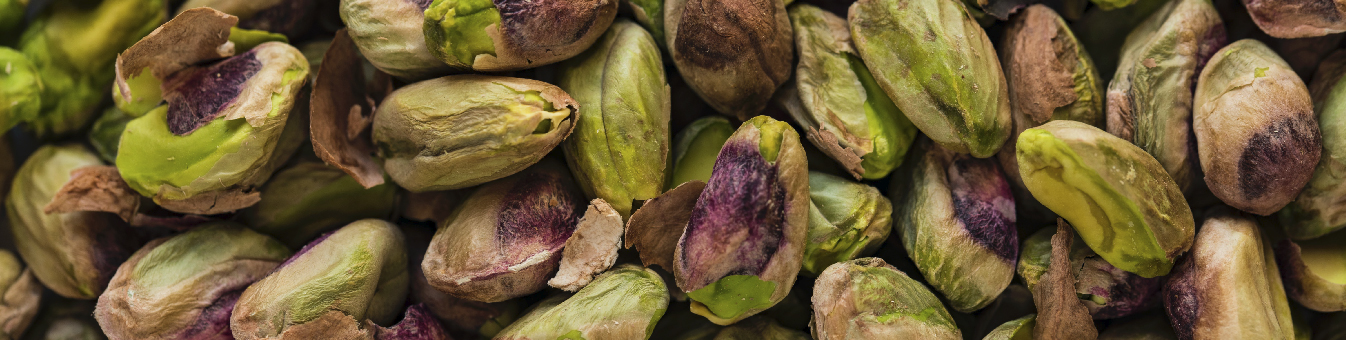

As of 2026, the global beverage industry has pivoted from simple hydration to “functional indulgence.” The pistachio (Pistacia vera), historically relegated to a snack, is now at the forefront of this shift. This article explores the lipid-protein interactions of pistachios and their role in creating stable, nutrient-dense beverage matrices, particularly in the context of plant-based milks and high-end mixology.
- Emulsion Stability and Rheological Properties in Plant-Based Milks
The primary challenge in non-dairy milks is “feathering” or phase separation in acidic environments (like coffee). Pistachios possess a unique globulin-to-albumin ratio that provides superior thermal stability.
- Nanofluidization: Recent research indicates that high-pressure homogenization of pistachio kernels creates a stable sub-micron emulsion. This results in a “mouthfeel” that mimics bovine milk more closely than almond or oat alternatives, due to the high concentration of Monounsaturated Fatty Acids (MUFAs).
- The 2026 Trend: “Pistachio Lattes” have evolved into “Bio-Active Beverages,” where the natural chlorophyll content of the pistachio is preserved through cold-pressing to act as a potent antioxidant agent.
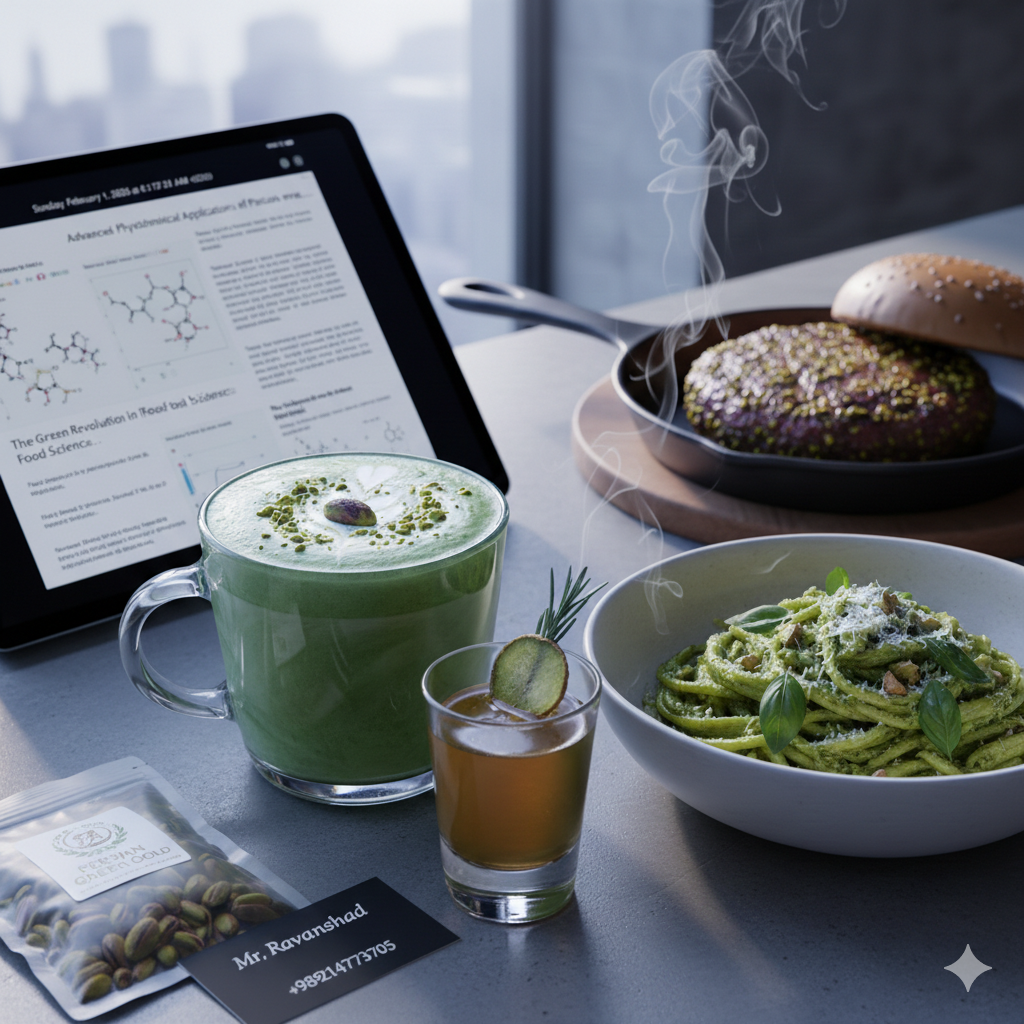
- Molecular Mixology: Beyond the Garnish
In modern mixology, pistachios are utilized for their aromatic complexity.
- Fat-Washing & Infusion: By leveraging the hydrophobic nature of pistachio oils, mixologists utilize “fat-washing” techniques to infuse spirits with a velvety texture and a nutty, earthy profile without the bitterness often found in walnuts.
- Terpene Profiling: Pistachios are rich in \alpha-pinene and limonene. In sophisticated cocktail formulations, these terpenes are extracted to provide a botanical bridge between citrus bases and heavy spirits, creating a multi-dimensional sensory experience.