

Introduction: The Invisible Challenge of Aflatoxin
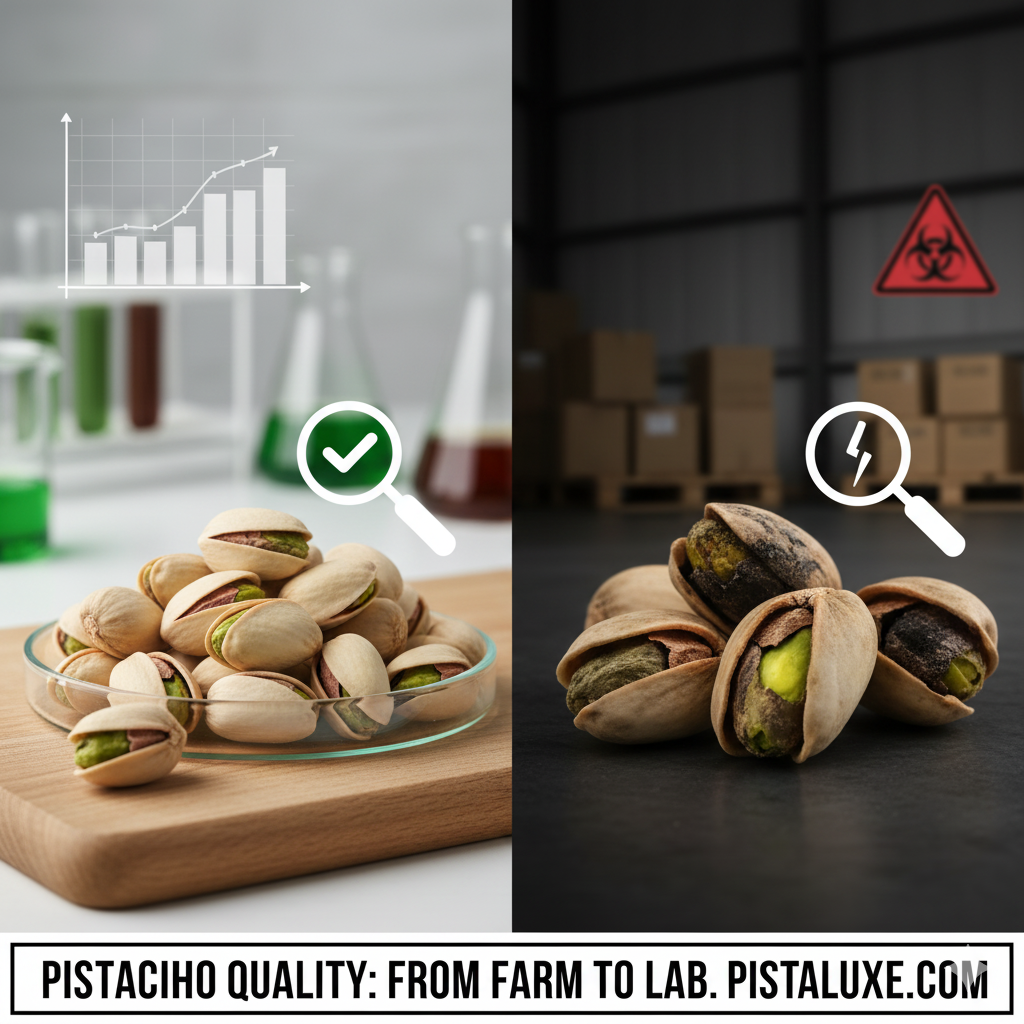
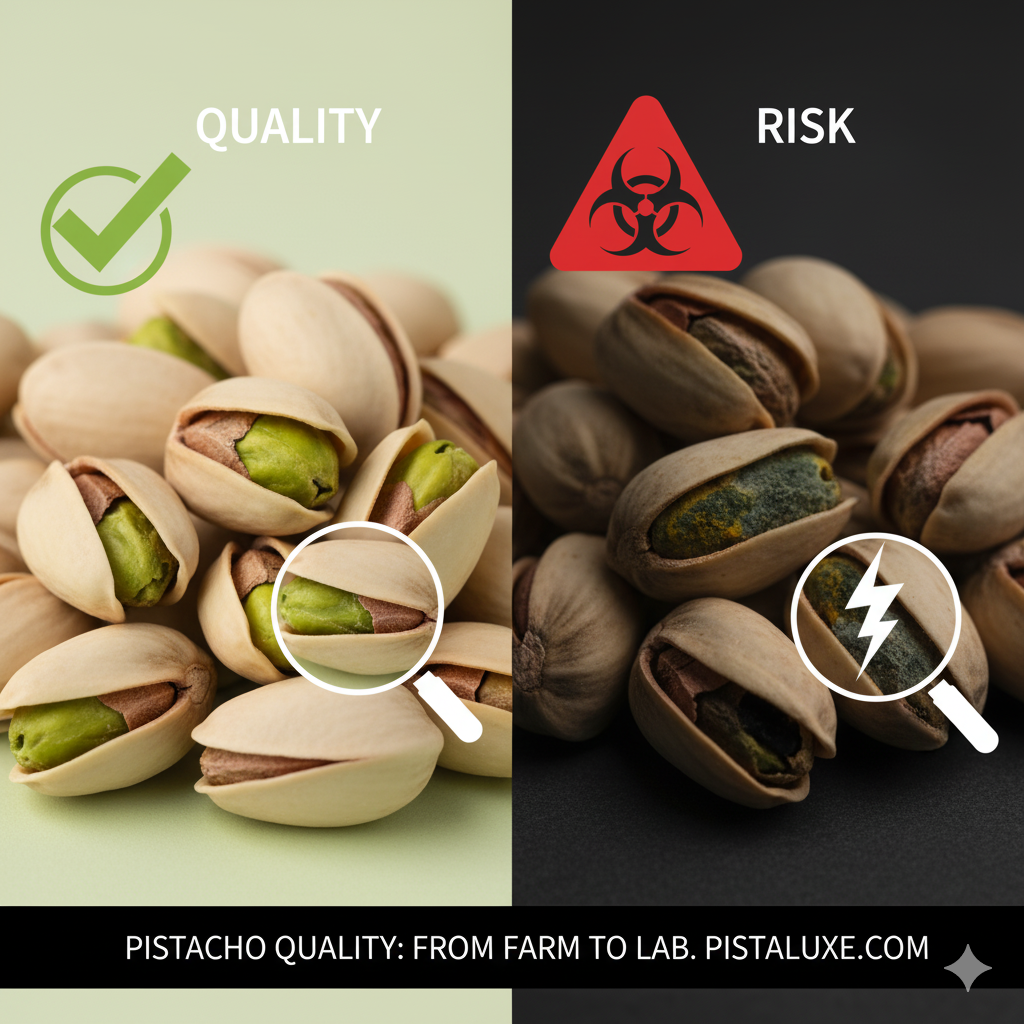
While the previous guide helped consumers visually identify overt contamination, the scientific reality is that Aflatoxin can be hazardous even at extremely low concentrations (measured in micrograms per kilogram or parts per billion (\text{ppb})), and these concentrations often have no visible symptoms. The primary challenge in the pistachio trade and consumption is the detection and quantification of this invisible contamination. This article explores the research aspects, international standards, and crucial preventative measures required across the entire supply chain.
Part 1: The Research Necessity for Accurate Laboratory Testing
- Sensitive Concentrations and Legal Limits:
- Nations worldwide set strict Maximum Limits for Total Aflatoxins (\text{B1+B2+G1+G2}) and particularly for the most toxic type, \text{B1}. For instance, the European Union mandates a very strict limit, often as low as \text{5 }\mu\text{g/kg} (\text{5 ppb}) for \text{B1}. Detecting these minute quantities requires highly sensitive analytical techniques.
- Gold Standard Laboratory Detection Methods:
- High-Performance Liquid Chromatography (HPLC): HPLC is recognized as the gold standard and most accurate quantitative method. It can separate and measure the four main types of Aflatoxin (\text{B1, B2, G1, G2}) with high resolution and extreme sensitivity.
- ELISA Technique (Enzyme-Linked Immunosorbent Assay): This is a faster and more cost-effective method used primarily for broad screening and large-scale sampling. While useful for initial checks, its accuracy is lower than HPLC.
- Fluorescence Detection: Aspergillus flavus exhibits a characteristic yellow-green fluorescence under ultraviolet (UV) light at around \text{365 nm}. This is a quick screening method used in processing plants, but it is not definitive, as fluorescence indicates mold presence, not necessarily toxin production.
Part 2: Preventative Measures and Risk Management Across the Supply Chain
Aflatoxin control is a multi-stage process that begins in the orchard and extends to the consumer’s kitchen: - Orchard Management and Pre-Harvest Prevention:
- Controlling Pests and Birds: Mechanical damage (like bird pecks) provides the primary route for mold to enter the kernel. Effective control of these pests is a key preventative measure.
- Water Management: Severe water stress followed by sudden irrigation can induce “Early Splitting,” the main precursor to contamination. Proper irrigation management is vital.
- Post-Harvest Processing and Storage:
- Avoiding Delays in Hulling: Pistachios must be hulled (the green outer layer removed) and washed immediately after harvest (within a maximum of \text{24} hours). Delays create a hot, moist environment ideal for fungal growth.
- Drying to a Safe Moisture Level: After hulling, the pistachios must be dried to a safe moisture content (typically less than \text{7\%}) to halt fungal activity.
- Crucial Home Storage Advice for Consumers:
- To maintain quality and prevent mold recurrence, always store pistachios in airtight, dry, cool, and dark containers.
- Storing pistachios in the refrigerator (below \text{4}^{\circ}\text{C}) or freezer (vacuum-sealed or in impermeable containers) is the best method to inhibit any microbial growth and preserve quality over the long term.
Research Summary and Final Recommendation
While home detection can save you from consuming grossly contaminated pistachios, the only true guarantee of safety comes from relying on reputable producers who offer products that meet national and international standards, backed by credible laboratory certificates. By adhering to these preventative storage tips, you can extend the shelf life and safety of your purchased pistachios.
📞 Order and Purchase Certified Quality Pistachios
For purchasing and placing orders for high-quality pistachios that comply with strict health standards, please contact Mr. Ravanshad via WhatsApp:
Mr. Ravanshad: \text{00989214773705}
Would you like any sections of these two extensive articles to be further elaborated or modified?