

Exporting ‘Virtual Water’ through Pistachio: An Economic Analysis of Value-to-Water Ratio and Groundwater Resource Tensions
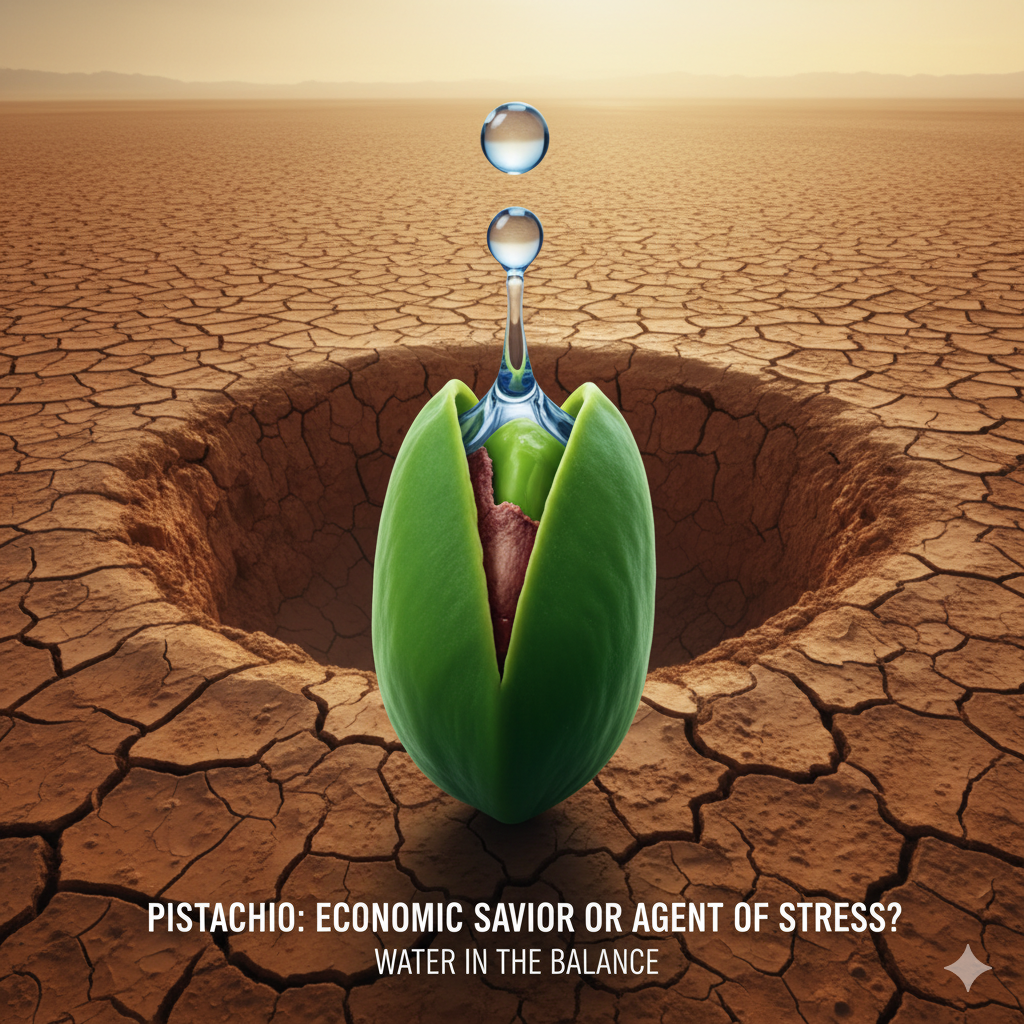
1. Introduction: The Conflict Between Foreign Exchange Earnings and Resource PreservationOver the past few decades, the Iranian pistachio industry has secured a critical position not merely as an agricultural commodity but as a key variable in the nation’s non-oil trade balance. This “Green Gold” generates substantial foreign currency earnings. However, this economic success has coincided with unprecedented challenges in water resources, particularly in major pistachio production hubs like Kerman, Yazd, and Khorasan. This reality brings forth a crucial question: Is this valuable crop truly an economic savior, or is it a driving force behind future resource tensions due to its reliance on non-renewable groundwater?This paper employs an economic and environmental approach to analyze the “Virtual Water” embedded in pistachio production, aiming to provide a balanced perspective on its economic value versus its environmental cost.2. Pistachio and the Concept of Virtual Water: A Look Behind the Export SceneThe concept of Virtual Water (VW) refers to the volume of water consumed throughout the entire production cycle of a commodity or service. When a kilogram of pistachios is exported, several cubic meters of water are, in effect, exported indirectly from the country.2.1. The Physical Cost: Water Consumption in Iranian vs. Global OrchardsAnalysis reveals that due to the prevalence of traditional irrigation methods (such as flood and basin irrigation) in many Iranian orchards, the Physical Water Use Efficiency in Iranian pistachio production is often lower than international standards (e.g., California).While American orchards may use a slightly higher absolute volume of water per hectare (due to sophisticated, uniform application and higher yields), their Water Use Efficiency (WUE) is superior. In Iran, factors like poor management, water salinity, and dated infrastructure significantly depress the overall efficiency of water utilized.
2.2. The Economic Value: Comparing Returns with Other CropsTo evaluate the economic viability of pistachio farming, we must calculate the Gross Economic Value (GEV) generated per cubic meter of water consumed (GEV / \text{m}^3) and compare it with other agricultural products. Due to its very high international price (multiple times that of wheat, rice, or many vegetables), pistachio typically boasts the highest rate of Economic Water Productivity (EWP) among Iranian agricultural exports.Economic Conclusion: From the standpoint of macroeconomics and balance of payments, pistachio export represents the most justifiable form of virtual water export in the agricultural sector, as it maximizes revenue for the nation.3. The Source of Tension: Unsustainable Extraction from Non-Renewable ResourcesThe core problem with pistachio cultivation is not just its water requirement, but the source of that water. Over 80\% of Iranian pistachio orchards rely on groundwater. In many central regions, increased cultivation and decreased rainfall have pushed water withdrawal far beyond the aquifers’ recharge capacity, leading to: * Severe Groundwater Depletion: This has resulted in the designation of many plains as “Prohibited Areas,” significantly reducing water availability for future generations. * Increased Salinity and Quality Degradation: As fresh groundwater tables drop, underlying saline water rises, threatening both soil quality and crop yield. This feedback loop further reduces the physical water-use efficiency. * Social Conflict: Heightened competition for limited water resources between pistachio farmers and other sectors, including drinking water supply.
4. Short-Term and Long-Term Solutions for SustainabilityTo maintain this strategic industry while responsibly managing water, a comprehensive plan is essential: * Short-Term Measures: * Imposing strict limits and monitoring on water extraction (using smart metering). * Providing immediate subsidies and incentives for transitioning from traditional flood irrigation to modern pressurized systems (drip, subsurface). * Long-Term Strategies: * True Water Pricing: Implementing water tariffs that internalize the environmental costs of extraction (cost of externalities). * Controlled Cultivation Shift: Gradually and strategically relocating pistachio farming to areas with more sustainable water resources or lower environmental risk. * Research and Development (R&D): Investing in rootstock and varieties with enhanced tolerance to salinity and drought (further explored in Article 2).5. Conclusion: A Strategic Balance is ImperativePistachio remains an economic savior as long as it stands as the most reliable source of foreign exchange in arid zones. However, if water management is not drastically reformed and unchecked extraction continues, it will swiftly become the irreversible agent of environmental and social tension. The future of the Iranian pistachio industry hinges on technology adoption, disciplined water management, and an honest valuation of water’s economic price.#BulkPistachioBuying