

Author: Mr. Ravanshad
Company: Pistaluxe (Qomes Tejarat Asia)
Reading time: ~8 minutes | Audience: Procurement Managers, Food Safety Officers, Quality Control Directors
Introduction: The High Cost of “Cheap” Pistachios
In the global commodity market, the temptation to prioritize the lowest unit price is constant. However, in the specialized world of pistachio procurement, a low price often masks deep-seated systemic risks. For European food manufacturers—where regulations are stringent and consumer trust is fragile—a single shipment of sub-standard pistachios can lead to massive product recalls, laboratory failures, and irreversible brand damage.
Understanding these “hidden” problems is the first step toward building a resilient, high-performance supply chain. In this article, we deconstruct the four most critical risks currently facing pistachio importers.
1. The Mycotoxin Trap: Beyond Simple Inspection
The most significant threat to any pistachio importer is the presence of Mycotoxins (specifically Aflatoxin).
- The Problem: Mycotoxins are invisible, tasteless, and heat-stable. Even if a shipment looks perfect and smells fresh, microscopic fungal growth can render an entire container illegal under EU Regulation 165/2010.
- The Complexity: Mycotoxin levels are not uniform. One part of a container may pass, while another fails. This “hot spot” phenomenon makes simple visual inspections useless.
- The Consequence: Discovering Aflatoxin at your facility (rather than at the origin) results in devastating costs: destruction of raw materials, wasted production time, and mandatory reporting to food safety authorities.
2. The “Visual Deception” of Grade and Size Consistency
In industrial manufacturing, consistency is more important than perfection.
- The Problem: Many suppliers promise “Premium Grade” or “Large Kernel” status, but once the nuts reach the production line, the reality differs. You may encounter high percentages of “splits,” “shrivelled kernels,” or “undersized nuts” mixed into the premium batch.
- The Impact on Production:
- In Gelato: Inconsistent kernel sizes lead to uneven distribution in the final product.
- In Chocolate: Small or broken kernels can interfere with automated coating and molding processes.
- In Spreads: Varied moisture levels in kernels cause separation or texture issues in the final paste.
- The Risk: Relying on a supplier that lacks rigorous, multi-stage mechanical sorting (color sorters and size graders) leads to unpredictable production yields.
3. Regulatory Volatility and the “Paperwork Gap”
The gap between a physical product and its documentation is where many B2B transactions fail.
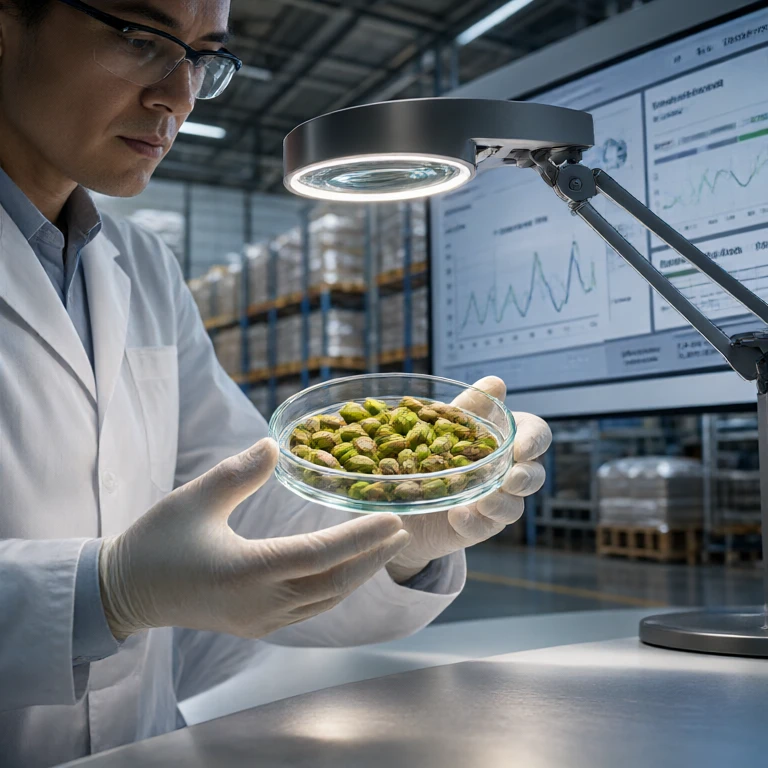
- The Problem: A shipment might be physically high-quality, but if the Certificate of Analysis (CoA) is outdated, doesn’t match the batch, or originates from a non-accredited lab, it is legally “unfit for purpose” in the EU.
- The Compliance Hurdle: With evolving standards like EU 2019/1793, documentation requirements for food safety are becoming more granular. Importers often find themselves stuck in customs because their supplier provided “standard” paperwork instead of “specialized regulatory” paperwork.
- The Consequence: Unexpected demurrage fees at ports, delayed production schedules, and the logistical nightmare of re-testing products in European labs at your own expense.
4. The Supply Chain “Black Box”: Lack of Origin Transparency
- The Problem: Many large-scale traders act as “middlemen of middlemen.” When you buy from a trader who does not have a direct link to the processing facility or the orchard, you lose visibility.
- The Risk of “Blending”: To meet sudden demand, some traders blend high-quality nuts with lower-grade “second-choice” stocks. Without direct traceability, the buyer has no way of knowing if the “premium” batch they ordered is actually a blend.
- The Impact: This lack of transparency makes it impossible to perform effective root-cause analysis when a quality issue eventually arises.
Conclusion: Shifting from “Transactional” to “Strategic” Sourcing
The risks outlined above—Mycotoxin contamination, size inconsistency, regulatory gaps, and lack of traceability—are not just “bad luck.” They are the direct results of transactional sourcing models that prioritize short-term margins over long-term stability.
For European manufacturers, the solution lies in Direct-to-Origin (DTO) partnerships. By working with a partner who controls the processing, manages the laboratory testing, and provides full transparency from the farm to the port, you transform your procurement from a source of risk into a source of competitive advantage.
Are you facing challenges with your current pistachio supply? Let’s discuss how a more transparent, quality-first approach can stabilize your production.
📞 Connect with Us Directly
- Direct WhatsApp / Call: +98 921 477 3705
- Professional Email: info@pistaluxe.com
- Official Website: pistaluxe.com