

Author: Mr. Ravanshad
Company: Pistaluxe (Qomes Tejarat Asia)
Reading time: ~9 minutes | Audience: Importers, food manufacturers, QA & procurement managers
Introduction: Why “Problems” Are the Wrong Starting Point
Every importer knows the list of pistachio complaints: aflatoxin, uneven grading, price shocks, late containers, and a supplier who goes silent after payment. What most buyers lack is not a list of problems — it is a documented, actionable protocol for each one.
This playbook is different. For every problem, you will find the root cause, the concrete actions a buyer can enforce, the standards and regulations to cite in your purchase contract, and how Pistaluxe implements it in practice. The goal is that you can copy these protocols into your next RFQ.
Problem 1: Aflatoxin and Mycotoxin Rejection at the EU Border
Root cause: Aflatoxin is not a processing defect — it is an agricultural one. It begins in the orchard (insect damage, drought stress, late harvest) and is amplified by slow drying and warm, humid storage. Once contamination exists, no amount of sorting fully removes it.
The regulatory benchmark you should cite:
- Commission Regulation (EU) No 165/2010 amending Regulation (EC) No 1881/2006 sets maximum levels for pistachios intended for direct human consumption: 8 µg/kg total aflatoxins and 5 µg/kg aflatoxin B1 (for nuts “ready to eat”); stricter limits apply to products intended for further sorting or processing.
- EU Implementing Regulation (EU) 2019/1793 places pistachios from certain origins under increased official controls at the EU border (documentary, identity, and physical checks including sampling for aflatoxins). This is the single most important document for anyone importing pistachios into the EU today — verify the current annex status for your origin before booking cargo.
- Codex Alimentarius guidance on mycotoxin management in tree nuts, and the Codex Code of Practice for the Prevention and Reduction of Aflatoxins in Tree Nuts (CXC 59-2005).
Actionable protocol:
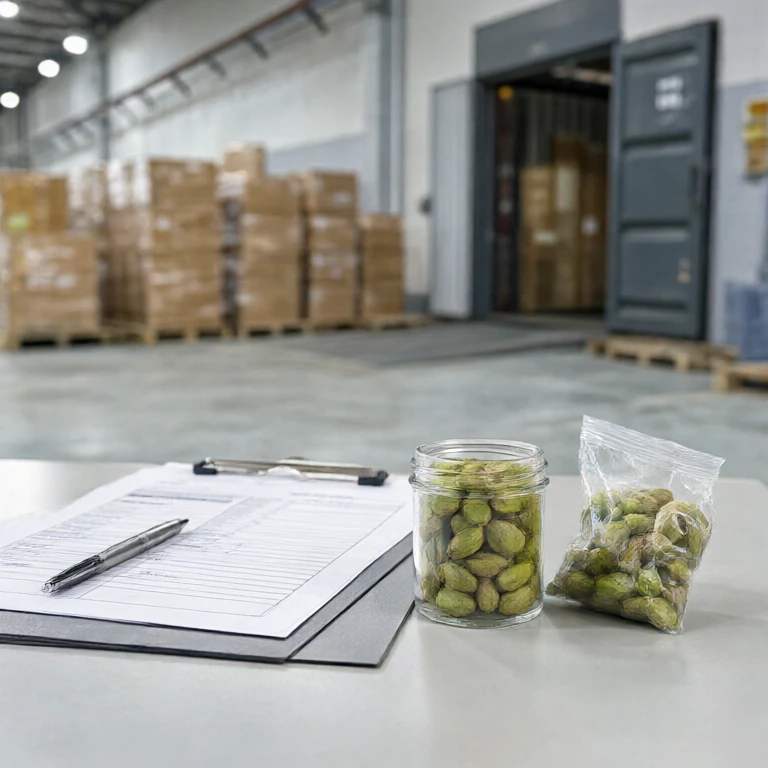
- Contract the sampling method, not just the limit. Specify that sampling follows Commission Regulation (EU) No 401/2006 (sampling and analysis methods for mycotoxins) — 20 kg aggregate sample, laboratory sub-sample of 10 kg. A supplier who cannot name the sampling method is not controlling the risk.
- Require pre-shipment CoA from an ISO/IEC 17025-accredited laboratory, with the lab name, method, and result — not a generic “certificate of health.”
- Insert a rejection clause with a defined remedy: re-testing by a mutually agreed referee lab, and cost allocation if the referee confirms non-compliance.
- Demand harvest-date traceability and drying records. Early-harvested, rapidly dried nuts carry a fundamentally lower risk profile.
How Pistaluxe implements it: moisture and drying parameters are controlled at the source immediately post-harvest; every export lot is tested by accredited third-party laboratories before container loading, and full documentation is shared with the buyer prior to shipment.
Problem 2: Quality Inconsistency — “Grade A” That Isn’t
Root cause: In the Iranian market, grading terminology is not standardized between traders. “Grade A” can mean different split ratios, different size counts, and different defect tolerances depending on who is speaking.
Actionable protocol:
- Never accept a grade name. Accept a specification sheet. Define, in the contract annex:
- Size count (kernels or nuts per ounce) for the specific variety — e.g., Akbari, Fandoghi, Ahmad Aghaei, Kalleh Ghouchi have different natural size profiles.
- Split ratio (percentage of open-shell nuts), closed-shell percentage, blank/empty percentage.
- Defect tolerances: broken kernels, shrivelled kernels, stained shells, foreign matter — each with a numeric maximum.
- Moisture content (typically ≤5–6% for kernels, depending on the product form).
- Agree on the inspection standard: ISO 3524 (pistachio nuts — specification) provides an internationally recognized reference framework for defect classification and tolerances. Reference it explicitly.
- Appoint a pre-shipment inspection (SGS, Bureau Veritas, Cotecna, or an equivalent) and make the report a condition of payment release.
- Keep a retained sample from each lot, sealed and dated, for dispute resolution.
How Pistaluxe implements it: mechanical and optical sorting combined with manual verification, per-lot CoA covering purity, moisture, split ratio, and kernel integrity, and retained samples available on request.
Problem 3: Price Volatility and Currency Risk
Root cause: Iranian pistachio pricing is exposed to three simultaneous variables: the annual crop volume (alternate bearing years and frost/drought events), global demand shifts (China and the EU are the dominant buyers), and FX movements affecting the rial-denominated farmgate price. Add freight rates and insurance, and a quote can be obsolete within weeks.
Actionable protocol:
- Separate the price into its components in every quote: farmgate product price + processing/sorting + packaging + inland transport + freight + insurance + certification. This makes renegotiation factual rather than emotional.
- Fix the crop year explicitly. A quote must state the harvest year and the crop’s quality characteristics. Never allow “current crop” as an undefined term.
- Use staged contracts: a firm price for the first container, a price band with a defined index for subsequent containers.
- Consider Incoterms deliberately: FOB gives you control of freight and insurance but exposes you to rate swings; CIF/CFR transfers that risk to the seller at a premium. Choose based on your freight forwarder relationships, not habit.
How Pistaluxe implements it: transparent, component-based quotations, confirmed harvest-year designation, and shipment scheduling agreed in writing before production begins.
Problem 4: Logistics Failure and Cargo Deterioration in Transit
Root cause: Pistachios are hygroscopic and high in oil. Warm, humid container atmospheres accelerate oxidative rancidity and can reactivate mold risk. The two most common failures are (a) loading product above the recommended moisture level, and (b) condensation inside the container during temperature cycling on long sea routes.
Actionable protocol:
- Specify packaging: food-grade, high-barrier liners (e.g., vacuum or nitrogen-flushed PE/foil liners) inside cartons or jumbo bags, with the liner specification written into the contract.
- Specify container conditions: ventilated or temperature-controlled containers for long routes and warm seasons; desiccant where appropriate; stowage away from heat sources.
- Require a loading report with photographs: container number, seal number, liner type, product condition, and loading date.
- Verify insurance covers the actual risk — marine cargo insurance with a clear statement on inherent vice and moisture damage.
How Pistaluxe implements it: moisture-barrier packaging, documented loading protocols, and full shipment documentation shared with the buyer at loading.
Problem 5: The Counterparty and Communication Gap
Root cause: Much of the Iranian pistachio trade still runs through fragmented intermediaries. The result: unclear accountability, slow responses, and disputes with no paper trail.
Actionable protocol:
- Insist on a named, documented counterparty with a verifiable company registration, export license, and a track record you can check.
- Put everything in writing — specification annex, inspection rights, delivery windows, force majeure definition, and a defined dispute resolution mechanism (arbitration seat and rules).
- Use a payment structure that matches risk: letter of credit, or staged payment tied to documented milestones (inspection passed → documents presented → balance released).
- Test responsiveness before you commit — the speed and quality of pre-contract answers is the most reliable predictor of post-contract behavior.
How Pistaluxe implements it: direct, English-language B2B communication led by Mr. Ravanshad, written specifications and documentation for every lot, and a single accountable point of contact from quotation to delivery.
Problem 6: Regulatory and Documentation Errors (The Silent Killer)
Root cause: A perfect cargo can be stopped by a missing or mismatched document — a phytosanitary certificate with a spelling error, an origin certificate inconsistent with the invoice, or a health certificate not matching the EU’s model requirements.
Actionable protocol:
- Build a document checklist and verify it before departure: commercial invoice, packing list, bill of lading, certificate of origin, phytosanitary certificate (per ISPM 12 / IPPC), health certificate where required, CoA, and any origin-specific documentation demanded under (EU) 2019/1793.
- Check name and address consistency across every document — customs systems match them literally.
- Confirm the import requirements of your specific member state, since national competent authorities may apply additional checks.
How Pistaluxe implements it: a standardized export document package reviewed against the destination country’s requirements before every shipment.
A One-Page Checklist You Can Send to Any Supplier
| # | Requirement | Standard / Reference | Enforceable? |
|---|---|---|---|
| 1 | Aflatoxin limits stated in contract | EU 165/2010 (8 µg/kg total; 5 µg/kg B1) | Yes — contract annex |
| 2 | Sampling method specified | EU 401/2006 (20 kg aggregate) | Yes — contract annex |
| 3 | Accredited lab CoA pre-shipment | ISO/IEC 17025 | Yes — payment condition |
| 4 | Product specification sheet | ISO 3524 framework | Yes — contract annex |
| 5 | Third-party pre-shipment inspection | SGS / BV / Cotecna | Yes — payment condition |
| 6 | Retained sealed samples | Internal QA policy | Yes — on request |
| 7 | Packaging & liner specification | Food-grade high-barrier liner | Yes — contract annex |
| 8 | Loading report with photos | Internal logistics protocol | Yes — document set |
| 9 | Complete document package | ISPM 12, IPPC, EU 2019/1793 | Yes — document set |
| 10 | Written dispute resolution | Arbitration clause | Yes — contract |
Conclusion: Risk Is Manageable When It Is Written Down
None of the problems above are unsolvable. What separates a smooth import program from a recurring crisis is whether the controls are documented, verifiable, and contractual — or left to trust and verbal assurance.
At Pistaluxe, we treat these protocols as the baseline of professional export, not an upgrade. If you would like the specification annex and document checklist above adapted to your product form, destination market, and volume, we are glad to prepare it for your team.
📞 Connect with Us Directly
- Direct WhatsApp / Call: +98 921 477 3705
- Professional Email: info@pistaluxe.com
- Official Website: pistaluxe.com