

By Mr. Ravanshad — CEO of Pistaluxe / Qomes Tejarat Asia
Why Variety Dictates Your Profit Margin
To an untrained eye, a pistachio is simply a pistachio. To a procurement director at a European confectionery house, however, the variety is a variable that determines production yields, flavor profiles, and ultimately, the retail price point of the finished product. Iran is not a monoculture producer; it is a mosaic of distinct cultivars, each with a unique genetic signature shaped by the semi-arid climate of Kerman, Rafsanjan, and Damghan.
Choosing the wrong variety for your application is one of the most common—and costly—mistakes in procurement. A paste manufacturer who buys a variety optimized for in-shell retail roasting will face lower kernel recovery rates, higher breakage during processing, and inconsistent color in the final product.
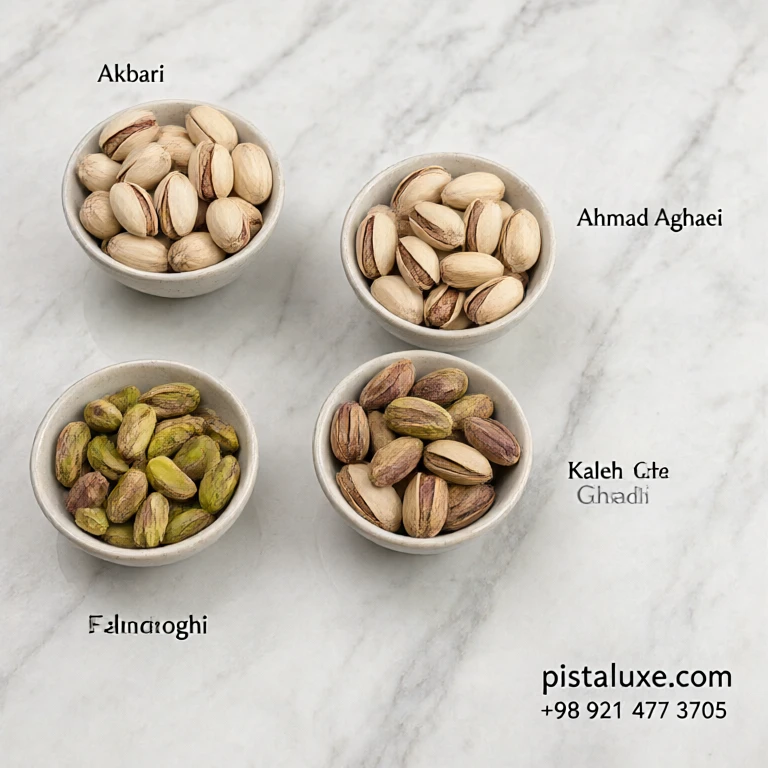
Below, I break down the four principal commercial varieties that dominate the Iranian export market, framed by their industrial utility, not just their marketing appeal.
1. Akbari — The Premium Flagship
Profile: Elongated, large size, high shell-to-kernel ratio. The Akbari is the largest and most visually striking Iranian cultivar, prized for its elongated shape and elegant appearance.
| Technical Indicator | Typical Specification |
|---|---|
| Size class | 20/22 to 26/28 (in-shell count per ounce) |
| Shell split rate | 85%–95% open |
| Color | Light green kernel, pale tan shell |
| Moisture at delivery | ≤ 5.5% |
| Best application | In-shell premium retail, gift packaging, luxury snack lines |
Strategic note for buyers: Akbari commands the highest price per kilogram in Western retail channels because of its presentation value. However, its lower cracking strength relative to smaller varieties means it requires gentler mechanical handling. If your market is a shell-on retail channel (German organic retailers, Italian luxury food halls), Akbari is your headline product.
2. Ahmed Aghaei — The Industrial Workhorse
Profile: Large and elongated, with a high proportion of fully open shells and an exceptional kernel-to-shell ratio.
Excellent for mechanical processing. It offers a strong balance of size, flavor volatility resistance, and yield.
- Size class: 22/24 to 26/28
- Shell split rate: 90%–98% (highest among major varieties)
- Best application: Bulk in-shell export, roasting lines, industrial sorting
This is the variety I most often recommend to importers entering the European market for the first time. Its high split rate translates into fewer closed shells—which are effectively “dead weight” in a shipment—and therefore a more predictable cost per sellable unit.
3. Fandoghi — The Volume Standard
Profile: Round, smaller, uniform. The classic “pistachio” shape familiar to most consumers.
- Size class: 28/30 to 32/34
- Best application: Kernel extraction, paste and butter production, ice cream and bakery ingredients
Fandoghi is where the majority of the Iranian crop’s volume sits. Because it is round and uniform, it is ideal for automated sorting and for processes where the visual presentation matters less than the yield of green kernel. For a gelato manufacturer in Italy, this is often the optimal input.
4. Kaleh Ghouchi — The Early Harvest Advantage
Profile: Large, broad, with a distinctive blunt top; harvested earliest in the season.
- Best application: Early-season contracts, premium in-shell, markets requiring early arrival
- Strategic note: Its early harvest window can be leveraged to capture favorable price positioning before the bulk of the crop arrives.
Kernel Grades: Where Real Value Is Created
For manufacturers buying kernels (green and round, or green and long), the conversation shifts entirely from shell appearance to kernel integrity. This is a critically under-discussed area in Iranian origin marketing.
| Grade | Description | Application |
|---|---|---|
| Whole kernel | Intact, unbroken | Chocolate enclosures, premium pastry |
| Split kernel | Broken along natural seam | Baking, energy bars |
| Diced | 3–5 mm dice | Confectionery coatings, sauces |
| Crumb | Fine particles | Ice cream, marzipan-style pastes |
Every percentage point of breakage in kernel delivery represents a direct margin loss for the buyer. A shipment specified as “whole kernel” that arrives with 6% breakage has, in practical terms, been downgraded to a split-kernel product while still being invoiced at whole-kernel prices. This is why contractual definition of grade specifications—with sample approval and independent pre-shipment analysis—must be a non-negotiable part of your purchasing protocol.
The Color Question
The vivid emerald color of premium Iranian kernels is a genuine biochemical advantage: it reflects the origin’s high level of natural antioxidants and favorable growing conditions during kernel development. However, color consistency across lots is impossible to guarantee without strict sorting protocols. Buyers should request L* a* b* color readings from a standardized spectrophotometer on each pre-shipment lot, rather than relying on photographs. A photographed sample under warm studio lighting will always look greener than a warehouse lot under fluorescent light.
This is the technical discipline I bring to Pistaluxe’s quality assurance process: measurable, documented, and repeatable specifications rather than marketing adjectives.
📞 Connect with Us Directly
Ready to discuss your specifications, request a sample, or receive a customized quote? Our team is ready to assist you in English, Persian, or Arabic.
- Direct WhatsApp/Call: +98 921 477 3705
- Professional Email: info@pistaluxe.com
- Official Website: pistaluxe.com